
Page 1 of 8
FOUNDATIONS ADVISORY
VECTOR ALIGNMENT | FICTIONAL SAMPLE
RelayForge: launching a self-serve product tier
1
VECTOR ALIGNMENT REPORT
Launching a self-serve product tier
RelayForge, Inc. | fictional sample | initiative sponsor plus five leadership-team participants
The team agrees that RelayForge should test self-serve. It does not yet agree on what
business system must be tested.
The strongest shared direction is toward a bounded pilot for teams under 25. The largest source of drag is not opposition; it is
competing definitions of the work. Some leaders describe a new acquisition and pricing motion. Others describe a broader
operating model encompassing provisioning, onboarding, billing, support, economics, and expansion.
SUGGESTED DISPOSITION
Approve a bounded pilot after the company defines its complete operating model,
accountable owner, protected capacity, and scale / reshape / stop thresholds.
MOST IMPORTANT NEXT
MOVE
Reopen the decision boundaries. Four of five leaders believe proceeding is effectively
decided, while the initiative sponsor believes the initiative remains meaningfully
shapeable.
HOW TO USE THIS REPORT
Use the vector maps to see the degree of directional alignment. Use the accompanying prose to understand the substance. Use
the final conversation plan to turn the diagnosis into explicit choices, boundaries, evidence, and ownership.
Privacy note: the report displays five anonymous participant arrows in different colors only so overlapping lines remain visible. Colors do not persist across
graphs and cannot be used to track an individual. Comments and roles are not attributed.
Page 2 of 8
FOUNDATIONS ADVISORY
VECTOR ALIGNMENT | FICTIONAL SAMPLE
RelayForge: launching a self-serve product tier
2
1 SUMMARY VECTOR MAP
DIRECTIONAL DIVERGENCE
ENABLEMENT DIVERGENCE
opposed
aligned
WHAT THE PICTURE SAYS
Different problems beneath the
distance
Every leader points at least partly toward the
contemplated initiative. The team is not divided into
simple supporters and opponents.
The upper vectors are separated primarily by
differences in the initiative's meaning, boundaries, or
strategic purpose. The lower vectors are separated
primarily by capacity, readiness, ownership, or
coordination. The prose throughout the report
explains where both sources are present.
HOW TO READ THE MAP: The bold black arrow is the initiative sponsor's stated direction. Angular distance shows the degree of separation. Upper-half
arrows are driven primarily by directional differences; lower-half arrows by enablement differences. Colors are anonymous visual separators and do not
persist across graphs. Vector Alignment compares independently supplied perspectives; it is not a vote, performance assessment, or determination that the
sponsor's position is correct.
Page 3 of 8
FOUNDATIONS ADVISORY
VECTOR ALIGNMENT | FICTIONAL SAMPLE
RelayForge: launching a self-serve product tier
3
2 COMPONENT VECTOR MAPS
DEFINITION AND DESTINATION
Shared customer, different product
The group agrees that the initiative should serve teams under 25
through a lower-touch buying journey. It differs on what RelayForge
must actually build. Some responses describe packaging and checkout;
others include automated provisioning, onboarding, support
boundaries, economics, and an upgrade path.
STRATEGIC THESIS AND EVIDENCE
Several theories of success
Leaders point toward demand capture, unaided activation, contribution
economics, platform reliability, and support scalability. These theories
can reinforce one another, but they have not yet been combined into a
single testable thesis. Without that synthesis, the same pilot result could
be called success by one function and failure by another.
DECISION BOUNDARIES AND OPENNESS
Proceeding feels predetermined
This is the widest spread in the assessment. The initiative sponsor
believes the initiative remains meaningfully shapeable, while four of five
leaders experience the central choice to proceed as substantially fixed.
Unless the remaining freedoms are named explicitly, the team may
offer implementation advice when strategic challenge is still needed.
Page 4 of 8
FOUNDATIONS ADVISORY
VECTOR ALIGNMENT | FICTIONAL SAMPLE
RelayForge: launching a self-serve product tier
4
2 COMPONENT VECTOR MAPS - CONTINUED
PRIORITY AND COMMITMENT
Commitment is not conviction
Participants are broadly willing to carry a legitimate final decision, but
they do not assign the initiative equal priority or strategic conviction.
High professional commitment therefore does not pull skeptical leaders
closer to the sponsor. The practical question is how much
organizational attention the initiative should receive before the pilot
resolves its central assumptions.
EXECUTION READINESS AND OWNERSHIP
Commitment exceeds capacity
Commitment is consistently high, but available capacity and
organizational readiness are not. Process, accountable ownership,
support design, and functional bandwidth constrain several leaders
even where strategic support is present. The company appears ready
to run a bounded pilot, not a general launch.
Page 5 of 8
FOUNDATIONS ADVISORY
VECTOR ALIGNMENT | FICTIONAL SAMPLE
RelayForge: launching a self-serve product tier
5
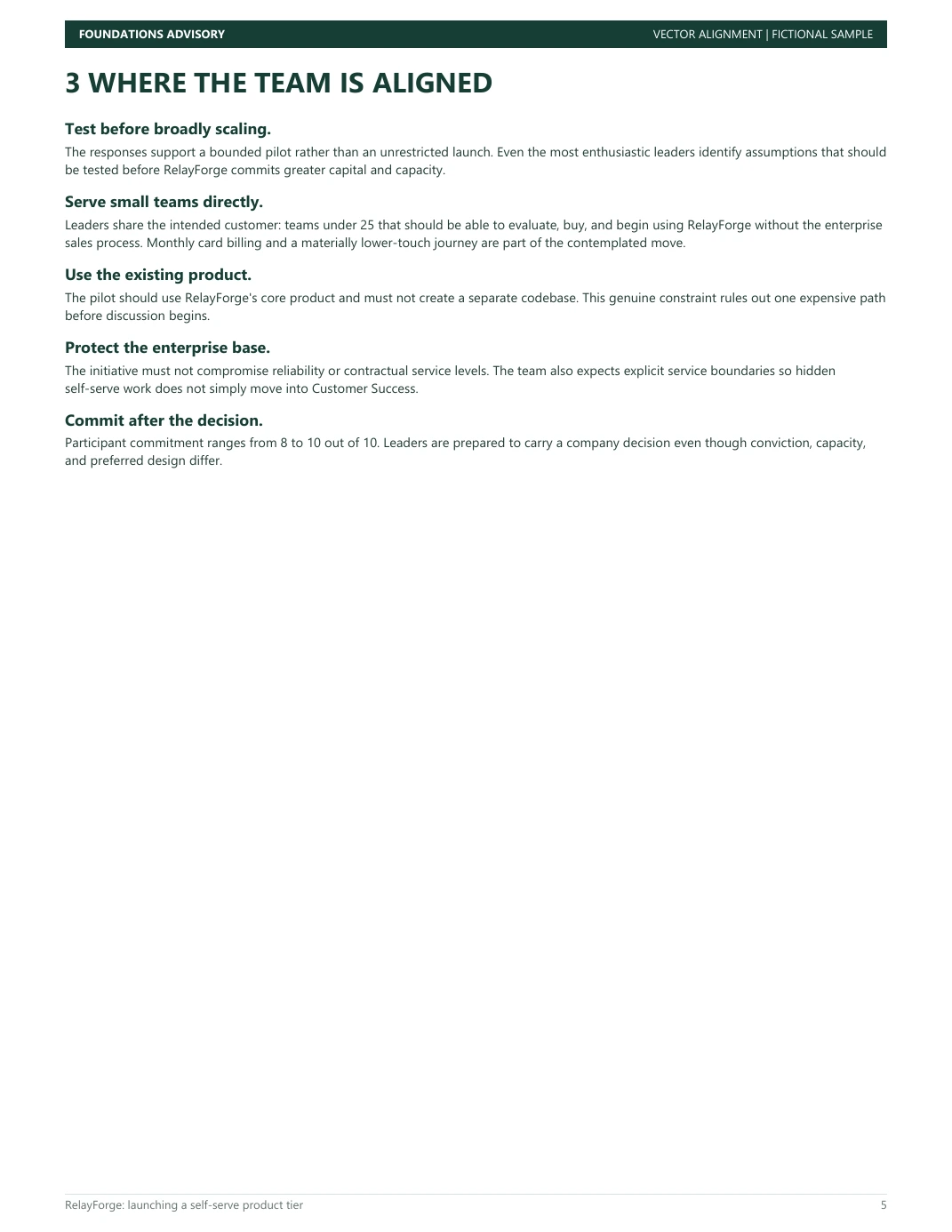
3 WHERE THE TEAM IS ALIGNED
Test before broadly scaling.
The responses support a bounded pilot rather than an unrestricted launch. Even the most enthusiastic leaders identify assumptions that should
be tested before RelayForge commits greater capital and capacity.
Serve small teams directly.
Leaders share the intended customer: teams under 25 that should be able to evaluate, buy, and begin using RelayForge without the enterprise
sales process. Monthly card billing and a materially lower-touch journey are part of the contemplated move.
Use the existing product.
The pilot should use RelayForge's core product and must not create a separate codebase. This genuine constraint rules out one expensive
path before discussion begins.
Protect the enterprise base.
The initiative must not compromise reliability or contractual service levels. The team also expects explicit service boundaries so hidden
self-serve work does not simply move into Customer Success.
Commit after the decision.
Participant commitment ranges from 8 to 10 out of 10. Leaders are prepared to carry a company decision even though conviction, capacity,
and preferred design differ.
Page 6 of 8
FOUNDATIONS ADVISORY
VECTOR ALIGNMENT | FICTIONAL SAMPLE
RelayForge: launching a self-serve product tier
6
FOUNDATIONS ADVISORY
VECTOR ALIGNMENT | FICTIONAL SAMPLE
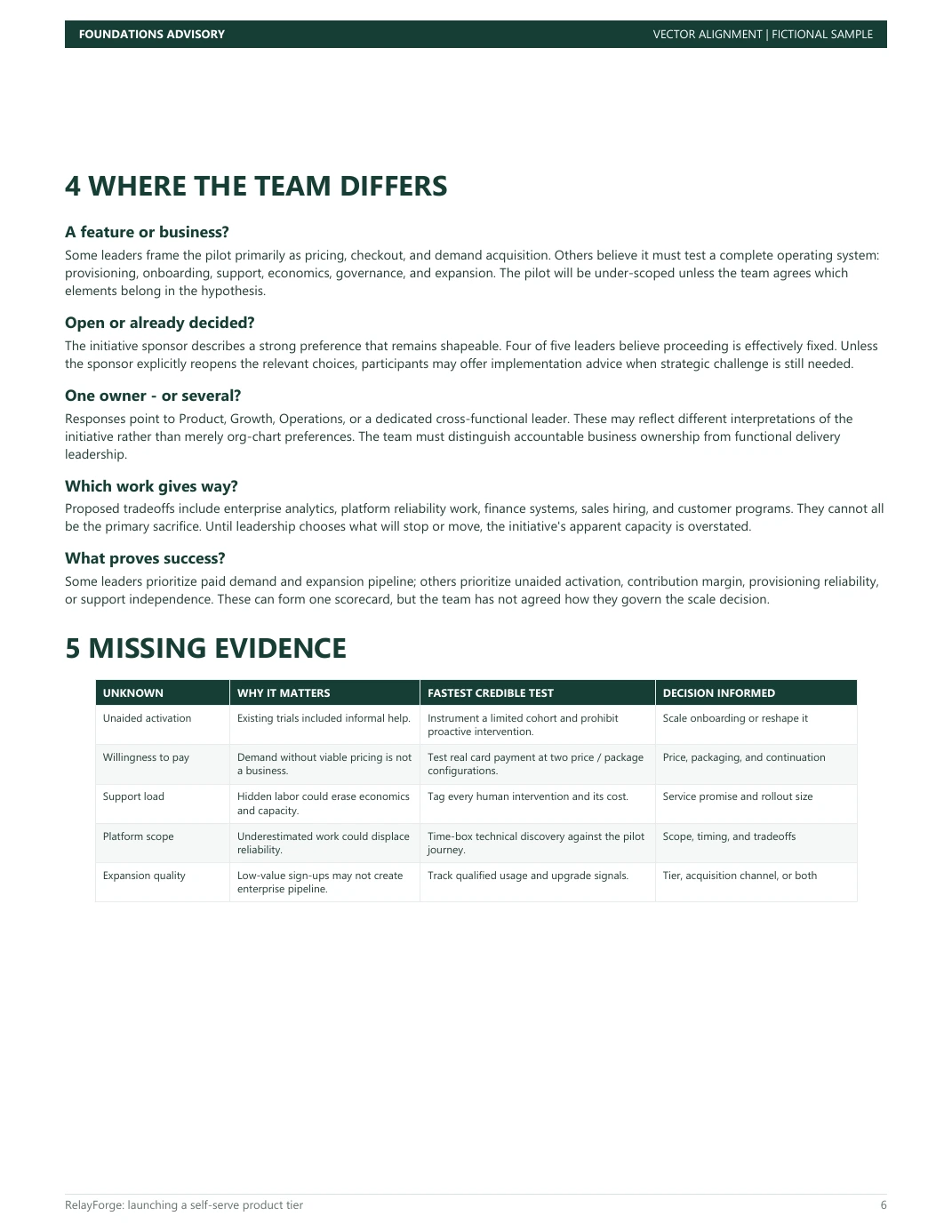
4 WHERE THE TEAM DIFFERS
A feature or business?
Some leaders frame the pilot primarily as pricing, checkout, and demand acquisition. Others believe it must test a complete operating system:
provisioning, onboarding, support, economics, governance, and expansion. The pilot will be under-scoped unless the team agrees which
elements belong in the hypothesis.
Open or already decided?
The initiative sponsor describes a strong preference that remains shapeable. Four of five leaders believe proceeding is effectively fixed. Unless
the sponsor explicitly reopens the relevant choices, participants may offer implementation advice when strategic challenge is still needed.
One owner - or several?
Responses point to Product, Growth, Operations, or a dedicated cross-functional leader. These may reflect different interpretations of the
initiative rather than merely org-chart preferences. The team must distinguish accountable business ownership from functional delivery
leadership.
Which work gives way?
Proposed tradeoffs include enterprise analytics, platform reliability work, finance systems, sales hiring, and customer programs. They cannot
all be the primary sacrifice. Until leadership chooses what will stop or move, the initiative's apparent capacity is overstated.
What proves success?
Some leaders prioritize paid demand and expansion pipeline; others prioritize unaided activation, contribution margin, provisioning reliability, or
support independence. These can form one scorecard, but the team has not agreed how they govern the scale decision.
5 MISSING EVIDENCE
UNKNOWN
WHY IT MATTERS
FASTEST CREDIBLE TEST
DECISION INFORMED
Unaided activation
Existing trials included informal help.
Instrument a limited cohort and prohibit
proactive intervention.
Scale onboarding or reshape it
Willingness to pay
Demand without viable pricing is not
a business.
Test real card payment at two price / package
configurations.
Price, packaging, and continuation
Support load
Hidden labor could erase economics
and capacity.
Tag every human intervention and its cost.
Service promise and rollout size
Platform scope
Underestimated work could displace
reliability.
Time-box technical discovery against the pilot
journey.
Scope, timing, and tradeoffs
Expansion quality
Low-value sign-ups may not create
enterprise pipeline.
Track qualified usage and upgrade signals.
Tier, acquisition channel, or both
Page 7 of 8
FOUNDATIONS ADVISORY
VECTOR ALIGNMENT | FICTIONAL SAMPLE
RelayForge: launching a self-serve product tier
7
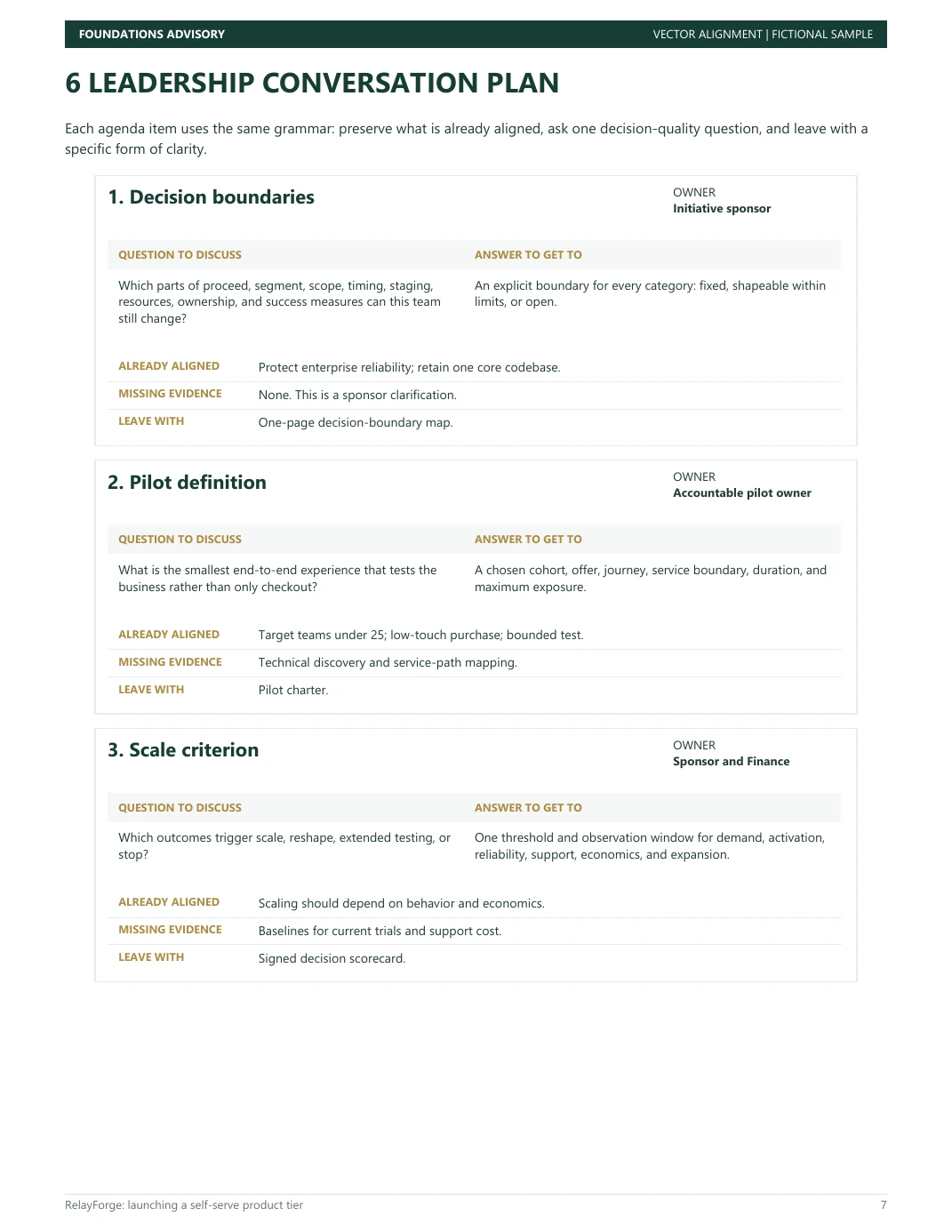
6 LEADERSHIP CONVERSATION PLAN
Each agenda item uses the same grammar: preserve what is already aligned, ask one decision-quality question, and leave with a
specific form of clarity.
1. Decision boundaries
OWNER
Initiative sponsor
QUESTION TO DISCUSS
ANSWER TO GET TO
Which parts of proceed, segment, scope, timing, staging,
resources, ownership, and success measures can this team
still change?
An explicit boundary for every category: fixed, shapeable within
limits, or open.
ALREADY ALIGNED
Protect enterprise reliability; retain one core codebase.
MISSING EVIDENCE
None. This is a sponsor clarification.
LEAVE WITH
One-page decision-boundary map.
2. Pilot definition
OWNER
Accountable pilot owner
QUESTION TO DISCUSS
ANSWER TO GET TO
What is the smallest end-to-end experience that tests the
business rather than only checkout?
A chosen cohort, offer, journey, service boundary, duration, and
maximum exposure.
ALREADY ALIGNED
Target teams under 25; low-touch purchase; bounded test.
MISSING EVIDENCE
Technical discovery and service-path mapping.
LEAVE WITH
Pilot charter.
3. Scale criterion
OWNER
Sponsor and Finance
QUESTION TO DISCUSS
ANSWER TO GET TO
Which outcomes trigger scale, reshape, extended testing, or
stop?
One threshold and observation window for demand, activation,
reliability, support, economics, and expansion.
ALREADY ALIGNED
Scaling should depend on behavior and economics.
MISSING EVIDENCE
Baselines for current trials and support cost.
LEAVE WITH
Signed decision scorecard.
Page 8 of 8
FOUNDATIONS ADVISORY
VECTOR ALIGNMENT | FICTIONAL SAMPLE
RelayForge: launching a self-serve product tier
8
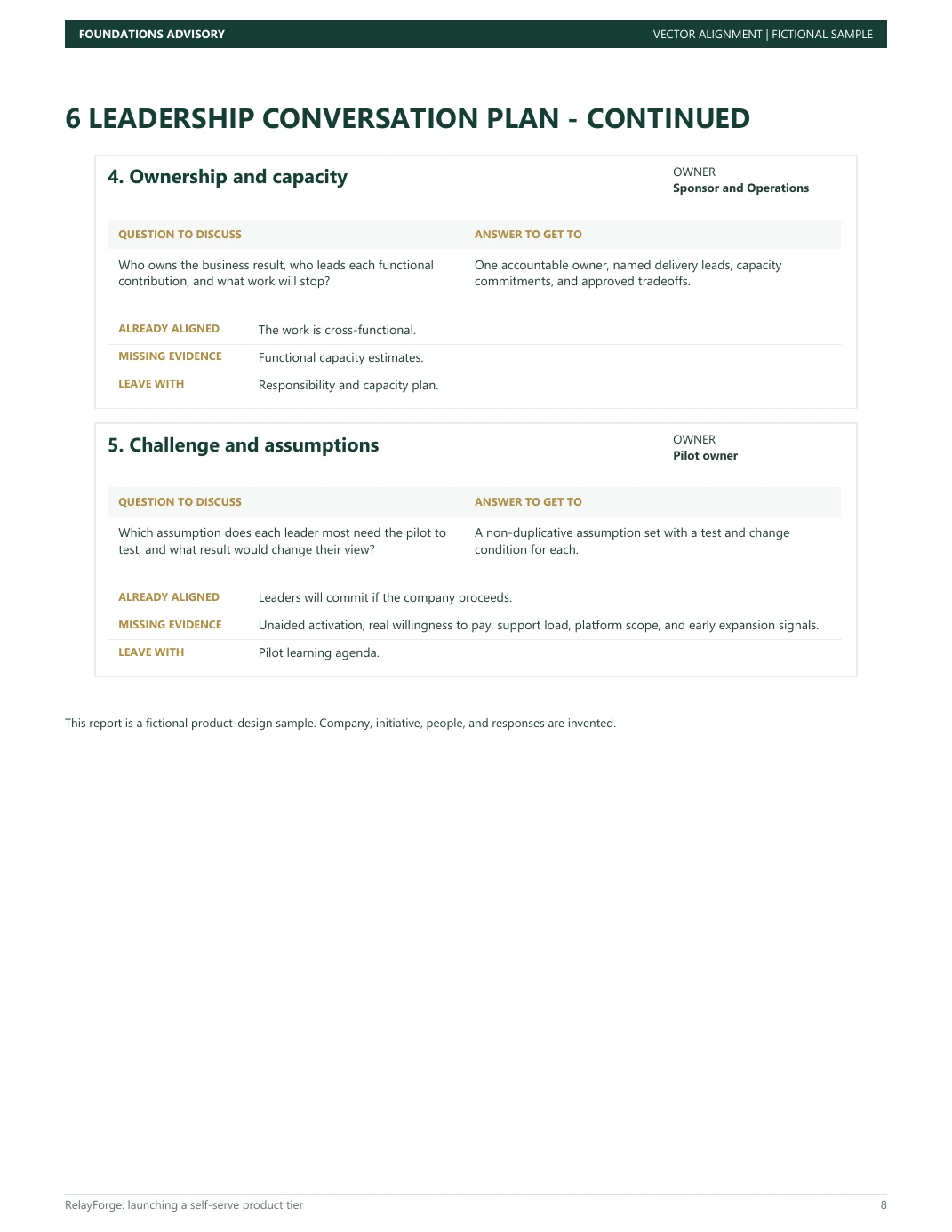
6 LEADERSHIP CONVERSATION PLAN - CONTINUED
4. Ownership and capacity
OWNER
Sponsor and Operations
QUESTION TO DISCUSS
ANSWER TO GET TO
Who owns the business result, who leads each functional
contribution, and what work will stop?
One accountable owner, named delivery leads, capacity
commitments, and approved tradeoffs.
ALREADY ALIGNED
The work is cross-functional.
MISSING EVIDENCE
Functional capacity estimates.
LEAVE WITH
Responsibility and capacity plan.
5. Challenge and assumptions
OWNER
Pilot owner
QUESTION TO DISCUSS
ANSWER TO GET TO
Which assumption does each leader most need the pilot to
test, and what result would change their view?
A non-duplicative assumption set with a test and change
condition for each.
ALREADY ALIGNED
Leaders will commit if the company proceeds.
MISSING EVIDENCE
Unaided activation, real willingness to pay, support load, platform scope, and early expansion signals.
LEAVE WITH
Pilot learning agenda.
This report is a fictional product-design sample. Company, initiative, people, and responses are invented.