
Page 1 of 9
TEAM GAP ASSESSMENT
Northline Monitoring
Preparedness today and for the work ahead
THE COMPANY
Northline is a twenty-two-person company that installs
equipment sensors and provides ongoing monitoring for small
manufacturers.
ASSESSMENT PURPOSE
Understand the team's strengths, the gaps likely to emerge as
demands change, and the gaps that already leave it unprepared
for important work.
The report assesses the whole team in its business
environment, with current work and foreseeable demands in
view.
SPONSOR
Maya Holt
Founder and CEO
ASSESSMENT DATE
14 October 2026
FOUR LENSES ON THE TEAM
Dispositions
How people tend to approach work and
contribute.
Skills and abilities
What people can do effectively.
Knowledge
What people understand and can apply.
Experience
The relevant situations people have handled.
Northline Monitoring | Team Gap Assessment
1 / 9
Page 2 of 9
TEAM GAP ASSESSMENT
The overall diagnosis
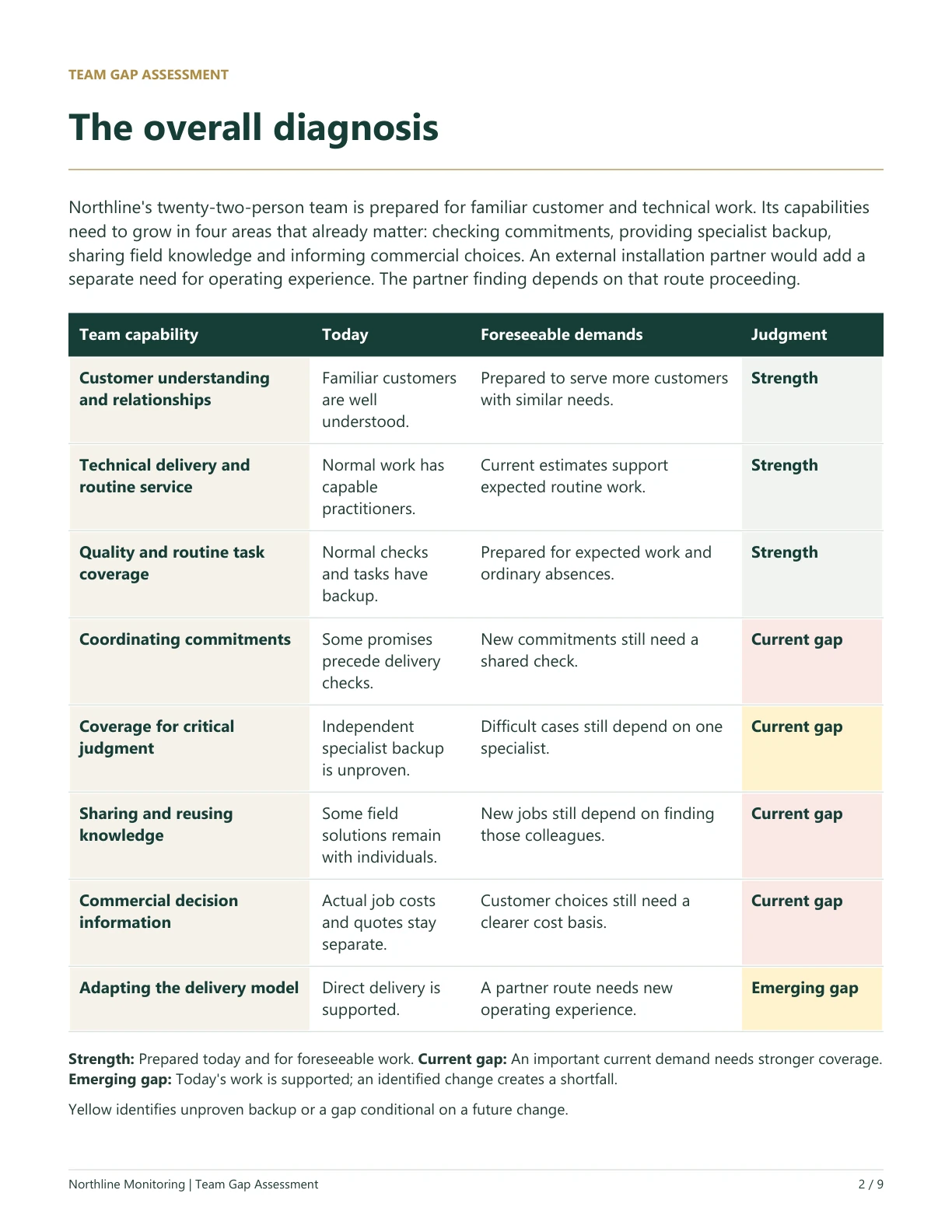
Northline's twenty-two-person team is prepared for familiar customer and technical work. Its capabilities
need to grow in four areas that already matter: checking commitments, providing specialist backup,
sharing field knowledge and informing commercial choices. An external installation partner would add a
separate need for operating experience. The partner finding depends on that route proceeding.
Team capability
Today
Foreseeable demands
Judgment
Customer understanding
and relationships
Familiar customers
are well
understood.
Prepared to serve more customers
with similar needs.
Strength
Technical delivery and
routine service
Normal work has
capable
practitioners.
Current estimates support
expected routine work.
Strength
Quality and routine task
coverage
Normal checks
and tasks have
backup.
Prepared for expected work and
ordinary absences.
Strength
Coordinating commitments
Some promises
precede delivery
checks.
New commitments still need a
shared check.
Current gap
Coverage for critical
judgment
Independent
specialist backup
is unproven.
Difficult cases still depend on one
specialist.
Current gap
Sharing and reusing
knowledge
Some field
solutions remain
with individuals.
New jobs still depend on finding
those colleagues.
Current gap
Commercial decision
information
Actual job costs
and quotes stay
separate.
Customer choices still need a
clearer cost basis.
Current gap
Adapting the delivery model
Direct delivery is
supported.
A partner route needs new
operating experience.
Emerging gap
Strength: Prepared today and for foreseeable work. Current gap: An important current demand needs stronger coverage.
Emerging gap: Today's work is supported; an identified change creates a shortfall.
Yellow identifies unproven backup or a gap conditional on a future change.
Northline Monitoring | Team Gap Assessment
2 / 9
Page 3 of 9
TEAM GAP ASSESSMENT
The team in its business environment
Strength
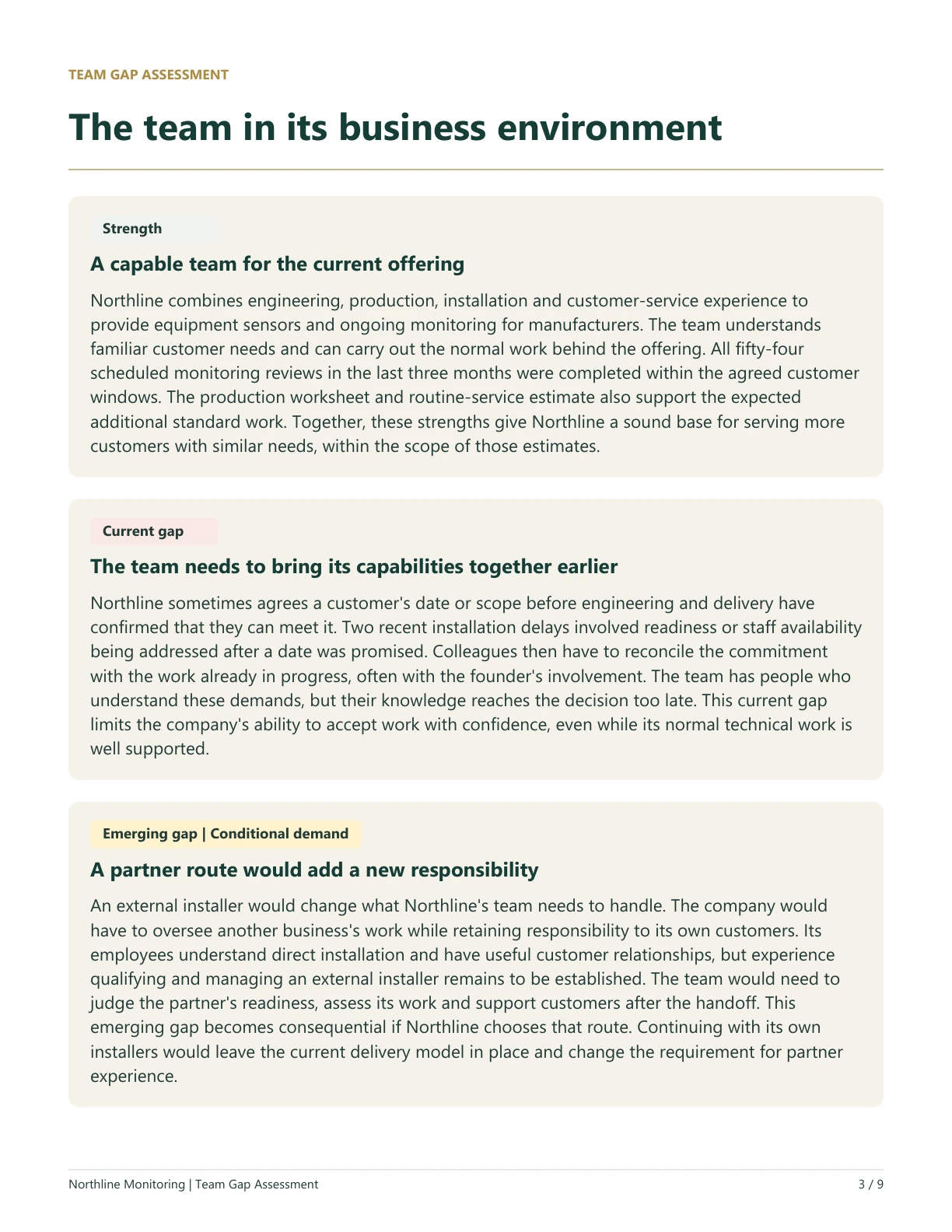
A capable team for the current offering
Northline combines engineering, production, installation and customer-service experience to
provide equipment sensors and ongoing monitoring for manufacturers. The team understands
familiar customer needs and can carry out the normal work behind the offering. All fifty-four
scheduled monitoring reviews in the last three months were completed within the agreed customer
windows. The production worksheet and routine-service estimate also support the expected
additional standard work. Together, these strengths give Northline a sound base for serving more
customers with similar needs, within the scope of those estimates.
Current gap
The team needs to bring its capabilities together earlier
Northline sometimes agrees a customer's date or scope before engineering and delivery have
confirmed that they can meet it. Two recent installation delays involved readiness or staff availability
being addressed after a date was promised. Colleagues then have to reconcile the commitment
with the work already in progress, often with the founder's involvement. The team has people who
understand these demands, but their knowledge reaches the decision too late. This current gap
limits the company's ability to accept work with confidence, even while its normal technical work is
well supported.
Emerging gap | Conditional demand
A partner route would add a new responsibility
An external installer would change what Northline's team needs to handle. The company would
have to oversee another business's work while retaining responsibility to its own customers. Its
employees understand direct installation and have useful customer relationships, but experience
qualifying and managing an external installer remains to be established. The team would need to
judge the partner's readiness, assess its work and support customers after the handoff. This
emerging gap becomes consequential if Northline chooses that route. Continuing with its own
installers would leave the current delivery model in place and change the requirement for partner
experience.
Northline Monitoring | Team Gap Assessment
3 / 9
Page 4 of 9
TEAM GAP ASSESSMENT
Dispositions
Strength
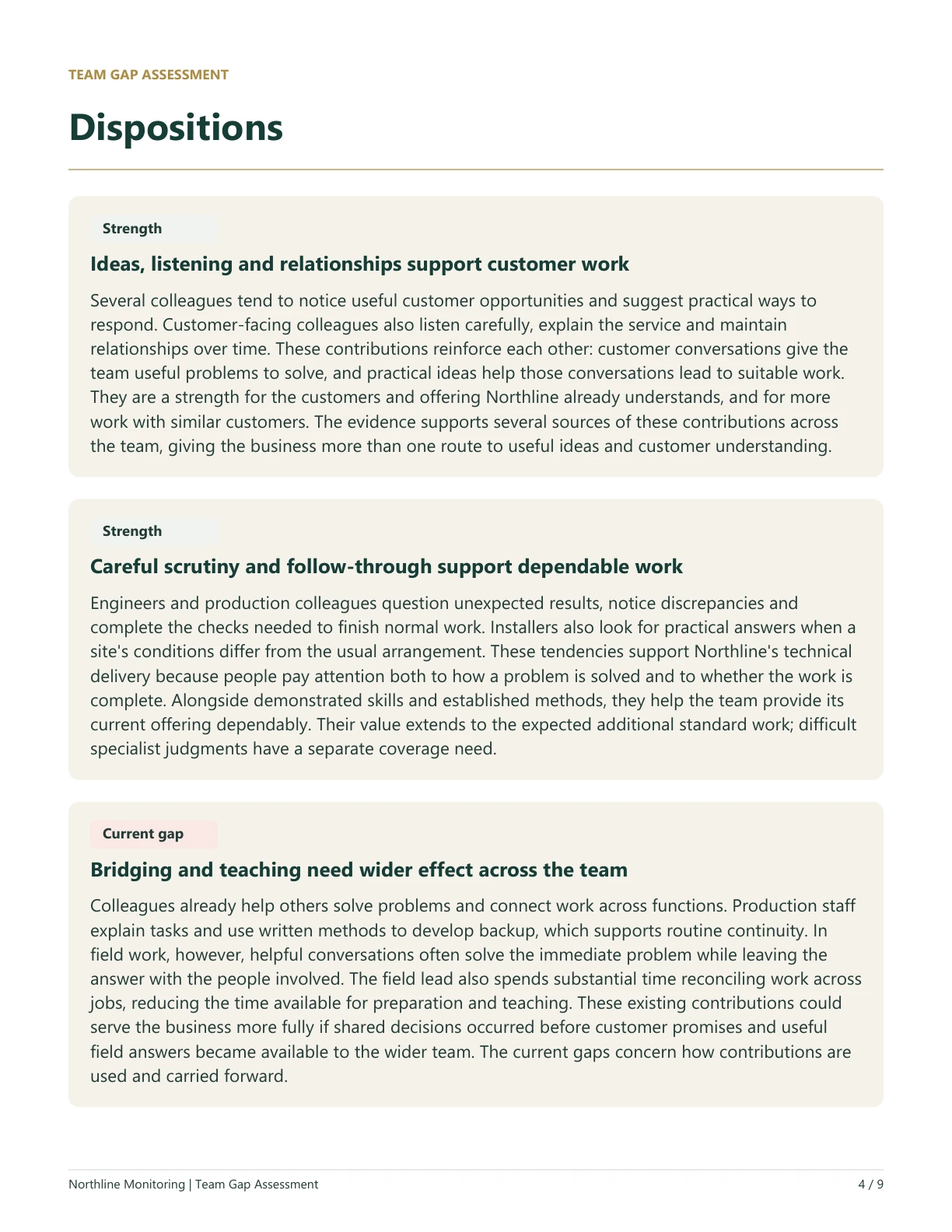
Ideas, listening and relationships support customer work
Several colleagues tend to notice useful customer opportunities and suggest practical ways to
respond. Customer-facing colleagues also listen carefully, explain the service and maintain
relationships over time. These contributions reinforce each other: customer conversations give the
team useful problems to solve, and practical ideas help those conversations lead to suitable work.
They are a strength for the customers and offering Northline already understands, and for more
work with similar customers. The evidence supports several sources of these contributions across
the team, giving the business more than one route to useful ideas and customer understanding.
Strength
Careful scrutiny and follow-through support dependable work
Engineers and production colleagues question unexpected results, notice discrepancies and
complete the checks needed to finish normal work. Installers also look for practical answers when a
site's conditions differ from the usual arrangement. These tendencies support Northline's technical
delivery because people pay attention both to how a problem is solved and to whether the work is
complete. Alongside demonstrated skills and established methods, they help the team provide its
current offering dependably. Their value extends to the expected additional standard work; difficult
specialist judgments have a separate coverage need.
Current gap
Bridging and teaching need wider effect across the team
Colleagues already help others solve problems and connect work across functions. Production staff
explain tasks and use written methods to develop backup, which supports routine continuity. In
field work, however, helpful conversations often solve the immediate problem while leaving the
answer with the people involved. The field lead also spends substantial time reconciling work across
jobs, reducing the time available for preparation and teaching. These existing contributions could
serve the business more fully if shared decisions occurred before customer promises and useful
field answers became available to the wider team. The current gaps concern how contributions are
used and carried forward.
Northline Monitoring | Team Gap Assessment
4 / 9
Page 5 of 9
TEAM GAP ASSESSMENT
Skills and abilities
Strength
Familiar technical and service work is well supported
The team can build and test the standard sensor equipment, maintain the software, install the
offering and complete normal customer reviews. Routine production checks and ordinary software
releases can be carried out by more than one colleague, giving those tasks practical coverage
during absences. These are demonstrated strengths in performing Northline's normal work. The
available capacity estimates support expected additional equipment builds and routine reviews,
although they cover those tasks specifically. They leave unusual equipment interpretation,
coordination across installation jobs and operation through a new partner to be considered
separately.
Current gap | Backup unproven
Independent backup for difficult judgments remains unproven
When equipment readings are hard to explain, Northline relies on one specialist to reach the final
judgment. All six recently reviewed unusual cases required that person's decision. A second
colleague participated in two cases under supervision, which shows a starting point for
development but leaves independent backup unproven. The team therefore has a current continuity
gap when the specialist is unavailable or several difficult cases coincide. Existing customer reviews
have been delivered successfully; the outstanding requirement is to demonstrate a second
dependable source of this judgment. The evidence does not establish how much future unusual
work will arise.
Current gap
Coordinating work requires time and decision authority
Northline has colleagues who can schedule work, connect functions and help resolve delivery
problems. Their current responsibilities leave limited room to coordinate the whole installation
workload, and customer dates can be agreed before that work has been checked. As a result, the
company's existing skills are used to repair commitments after they are made. This is a current gap
in the team's ability to make and maintain workable commitments. Closing it requires effective use
of coordination skills together with sufficient time and a clear role in the commitment decision. The
finding does not establish an individual skill deficiency.
Northline Monitoring | Team Gap Assessment
5 / 9
Page 6 of 9
TEAM GAP ASSESSMENT
Knowledge
Strength
Customer and technical understanding support the offering
Northline understands the manufacturers it currently serves, how its equipment is used and how to
explain the ongoing monitoring service. Technical colleagues can apply product knowledge in
ordinary installation and review work, while production staff use written quality criteria. This
knowledge is a strength for the current offering and similar customer needs ahead. Because familiar
work draws on several colleagues and established methods, much of the business can keep
operating through ordinary absences. The depth of understanding needed for unusual equipment
readings is more concentrated and has its own continuity gap.
Current gap
Useful field knowledge needs to become shared knowledge
Staff have found practical answers to problems at customer sites, but the team cannot consistently
retrieve and reuse those answers. Of six recent field adaptations reviewed, three were recorded
where others could find them, and none had been incorporated into the normal instructions.
Another colleague may therefore have to locate the person who remembers the solution before
proceeding. This current gap reduces the value Northline gets from knowledge it has already
developed. Production's written methods provide a useful example of stronger shared coverage
that field work can build on.
Current gap
Commercial choices need clearer knowledge of delivery costs
The accounts record travel and rework, but those costs are not routinely compared with the original
customer quote. Leaders consequently lack a readily available view of whether a customer's
additional requests are covered by the price. This is a current information gap in commercial
judgment, and the same incomplete basis will affect future quotes while the practice continues.
Northline already has accounting and cash oversight, so the recommendation is to connect existing
financial information to customer decisions. The assessment has not established the amount of any
effect on profit.
Northline Monitoring | Team Gap Assessment
6 / 9
Page 7 of 9
TEAM GAP ASSESSMENT
Experience
Strength
Direct delivery and familiar changes have a useful foundation
The team has substantial experience installing its own equipment, serving industrial customers and
managing ordinary production and software work. It has also worked through a production ramp
and an earlier software change, giving it relevant experience of adjusting familiar operations. These
strengths support continued development of the existing offering. The team has handled the
practical responsibilities behind direct delivery, including explaining the service and maintaining the
customer relationship. That experience gives Northline a credible starting point for more similar
work, supported by the current production and routine-service estimates.
Current gap | Backup unproven
Developing another source of judgment needs independent practice
A colleague's supervised involvement in difficult equipment cases is useful development experience,
but the reviewed cases still relied on the same specialist for the final decision. For the business to
have reliable backup, another practitioner needs experience carrying that responsibility successfully.
This current gap concerns dependable team coverage for a critical task. It can be addressed through
development or access to other suitable expertise, provided that independent performance is
demonstrated in the situations Northline actually faces. Ordinary monitoring success remains a
strength; continuity for difficult cases requires this additional evidence.
Emerging gap | Conditional demand
An external installer would require a new kind of experience
Northline has commercial relationships and employees who can explain its service, but it has no
established experience managing another company's installations. The proposed partner route
would require the team to judge an installer's readiness, agree who carries each responsibility,
assess completed work and support customers after the handoff. Current direct-delivery experience
helps the team understand what good work looks like; it leaves this external operating responsibility
to be developed. The resulting emerging gap applies if Northline proceeds with the partner route. A
future based on its own installers would change that requirement.
Northline Monitoring | Team Gap Assessment
7 / 9
Page 8 of 9
TEAM GAP ASSESSMENT
Recommendations
Bring the team into customer commitment decisions
Give technical and delivery colleagues a dependable role in confirming dates and scope before
Northline makes a customer promise. This is the first priority because it affects work the company is
accepting today and draws on expertise already present. The desired result is a team that can judge
a commitment together and keep it without repeated intervention from the founder. The
arrangement needs sufficient coordination time and clear authority to raise an unworkable
commitment.
Establish dependable coverage for critical judgment
Develop or secure another source of sound judgment for difficult equipment readings, with
independent performance demonstrated before Northline relies on it as backup. Supervised
participation provides a useful starting point. The desired result is continuity when the current
specialist is unavailable or demanding cases coincide. Determine the required breadth of coverage
from the cases the company actually handles, while preserving its dependable ordinary monitoring
service.
Make field learning available to the wider team
Make useful answers from customer sites easy for another colleague to find and apply. This
strengthens a current knowledge gap and helps Northline gain lasting value from work it has
already done. Production's written methods and routine cross-training provide a practical
foundation. The desired result is that familiar field problems can be handled dependably by the next
colleague, with less reliance on finding the person who remembers the answer.
Northline Monitoring | Team Gap Assessment
8 / 9
Page 9 of 9
TEAM GAP ASSESSMENT
Recommendations (cont'd)
Inform commercial choices with delivery costs
Connect the costs of customer variations with the original quote so leaders can judge what a
proposed price and scope require. Existing accounting records provide a foundation for this
improvement. The desired result is better-informed customer choices, including when additional
requests change the work involved. Establish the size and pattern of any economic effect before
selecting a response; the assessment has identified an information gap, while the effect on profit
remains unknown.
Prepare for partner delivery when that route is chosen
If Northline proceeds with an external installer, establish the knowledge and operating experience
needed to qualify the partner, judge its work and retain clear customer accountability. Readiness
should be demonstrated before the business depends on that route. The company's own
installation experience and customer relationships are useful assets for this preparation. A decision
to continue with direct delivery would change this priority while leaving the current gaps relevant.
Protect the strengths as responsibilities change
Preserve the team's customer understanding, careful technical work, routine backup and habit of
helping colleagues as these recommendations are developed. Changes should allow those
strengths to have greater effect across the business. Success means workable commitments,
dependable critical coverage, accessible shared knowledge and better-informed commercial
choices, alongside continued reliable normal service. These are the capability results Northline
should seek before selecting detailed staffing, training or operating arrangements.
Northline Monitoring | Team Gap Assessment
9 / 9