
Page 1 of 10
DECISION SPACE ASSESSMENT
Juniper Works
Local judgment. Clear boundaries. Reliable handovers.
COMPANY OVERVIEW
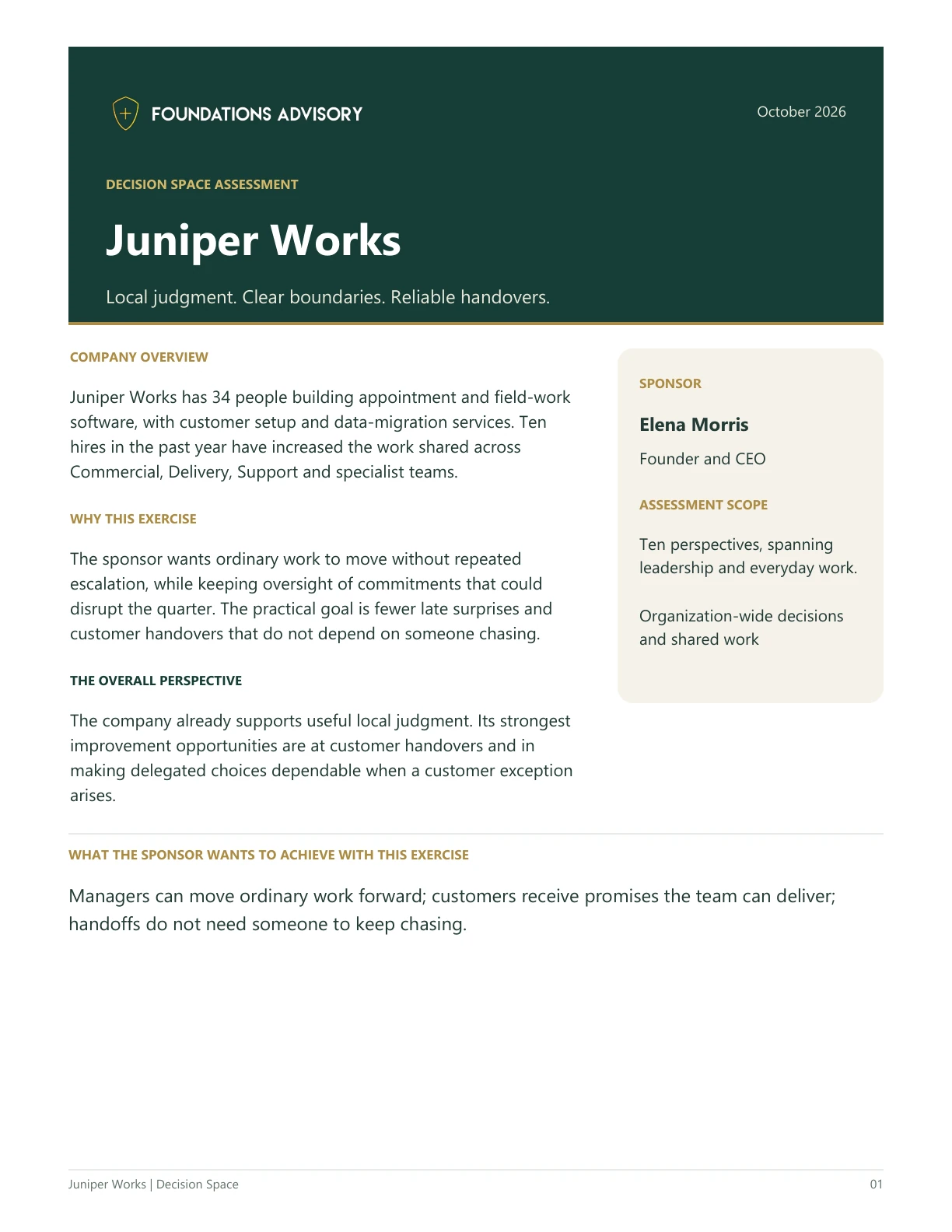
Juniper Works has 34 people building appointment and field-work
software, with customer setup and data-migration services. Ten
hires in the past year have increased the work shared across
Commercial, Delivery, Support and specialist teams.
WHY THIS EXERCISE
The sponsor wants ordinary work to move without repeated
escalation, while keeping oversight of commitments that could
disrupt the quarter. The practical goal is fewer late surprises and
customer handovers that do not depend on someone chasing.
THE OVERALL PERSPECTIVE
The company already supports useful local judgment. Its strongest
improvement opportunities are at customer handovers and in
making delegated choices dependable when a customer exception
arises.
SPONSOR
Elena Morris
Founder and CEO
ASSESSMENT SCOPE
Ten perspectives, spanning
leadership and everyday work.
Organization-wide decisions
and shared work
WHAT THE SPONSOR WANTS TO ACHIEVE WITH THIS EXERCISE
Managers can move ordinary work forward; customers receive promises the team can deliver;
handoffs do not need someone to keep chasing.
October 2026
Juniper Works | Decision Space
01
Page 2 of 10
THE WHOLE-COMPANY ENVIRONMENT
Useful freedom; uneven boundaries
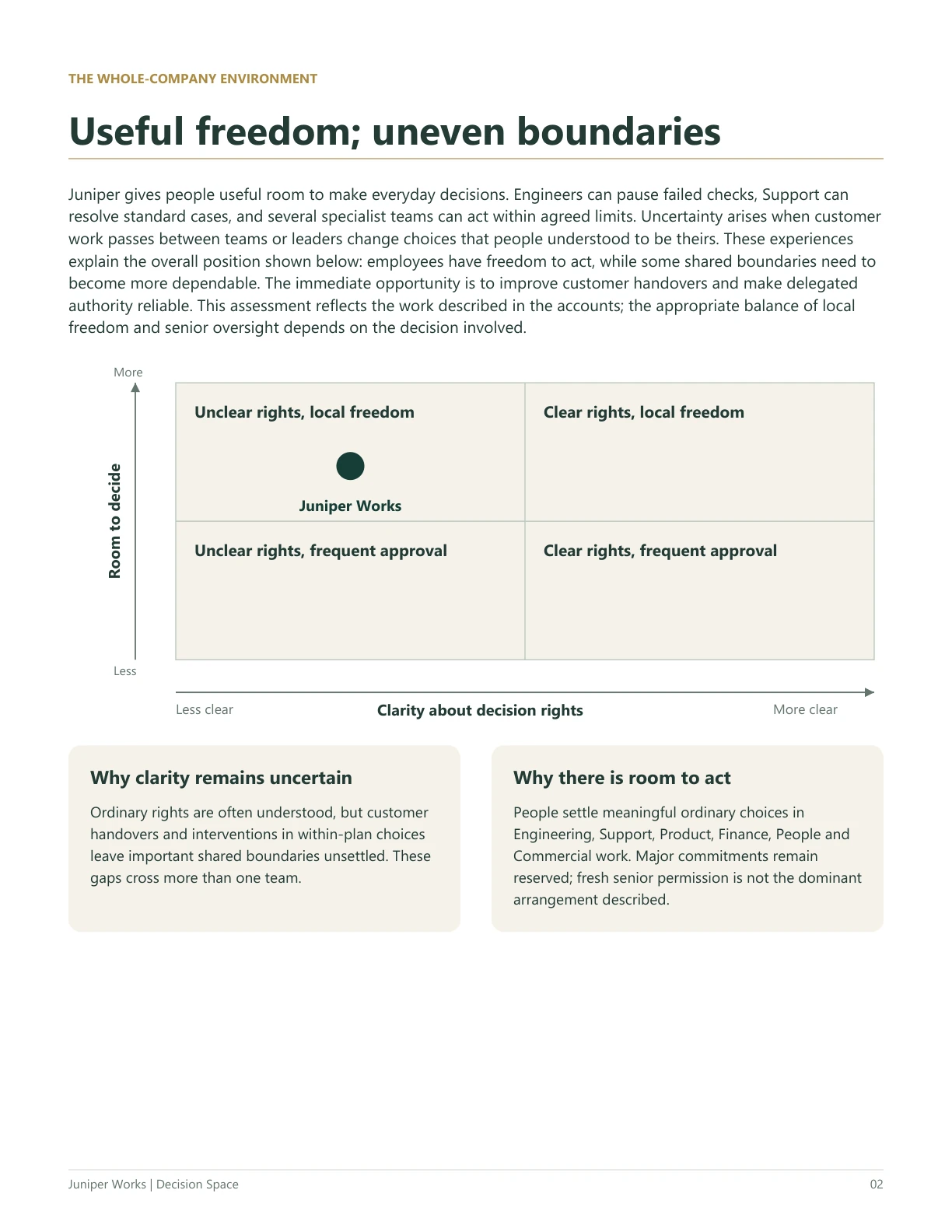
Juniper gives people useful room to make everyday decisions. Engineers can pause failed checks, Support can
resolve standard cases, and several specialist teams can act within agreed limits. Uncertainty arises when customer
work passes between teams or leaders change choices that people understood to be theirs. These experiences
explain the overall position shown below: employees have freedom to act, while some shared boundaries need to
become more dependable. The immediate opportunity is to improve customer handovers and make delegated
authority reliable. This assessment reflects the work described in the accounts; the appropriate balance of local
freedom and senior oversight depends on the decision involved.
Clear rights, local freedom
Unclear rights, local freedom
Clear rights, frequent approval
Unclear rights, frequent approval
Less clear
More clear
Clarity about decision rights
Room to decide
More
Less
Juniper Works
Why clarity remains uncertain
Ordinary rights are often understood, but customer
handovers and interventions in within-plan choices
leave important shared boundaries unsettled. These
gaps cross more than one team.
Why there is room to act
People settle meaningful ordinary choices in
Engineering, Support, Product, Finance, People and
Commercial work. Major commitments remain
reserved; fresh senior permission is not the dominant
arrangement described.
Juniper Works | Decision Space
02
Page 3 of 10
THE ORGANIZATIONAL CHECKUP
How decision making works
01
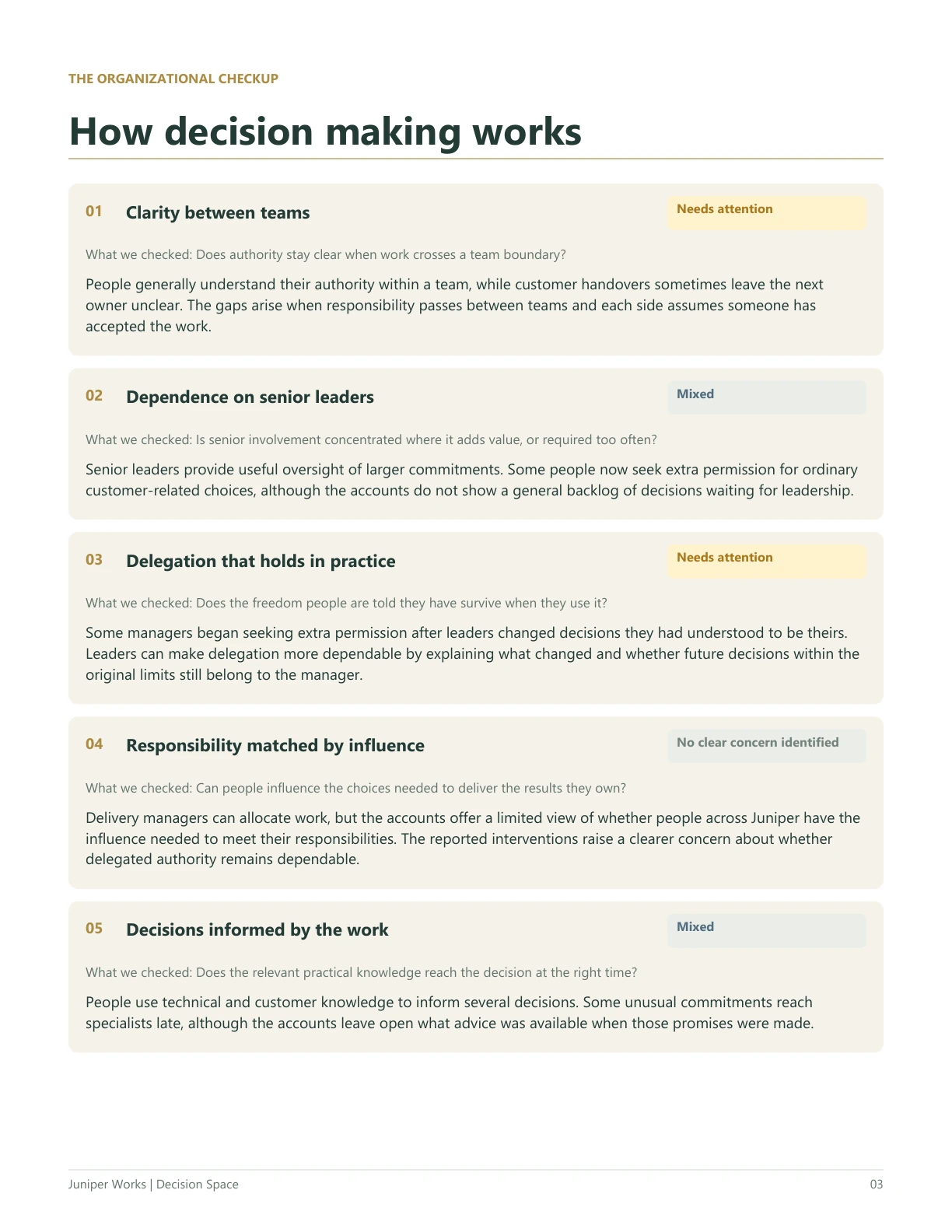
Clarity between teams
Needs attention
What we checked: Does authority stay clear when work crosses a team boundary?
People generally understand their authority within a team, while customer handovers sometimes leave the next
owner unclear. The gaps arise when responsibility passes between teams and each side assumes someone has
accepted the work.
02
Dependence on senior leaders
Mixed
What we checked: Is senior involvement concentrated where it adds value, or required too often?
Senior leaders provide useful oversight of larger commitments. Some people now seek extra permission for ordinary
customer-related choices, although the accounts do not show a general backlog of decisions waiting for leadership.
03
Delegation that holds in practice
Needs attention
What we checked: Does the freedom people are told they have survive when they use it?
Some managers began seeking extra permission after leaders changed decisions they had understood to be theirs.
Leaders can make delegation more dependable by explaining what changed and whether future decisions within the
original limits still belong to the manager.
04
Responsibility matched by influence
No clear concern identified
What we checked: Can people influence the choices needed to deliver the results they own?
Delivery managers can allocate work, but the accounts offer a limited view of whether people across Juniper have the
influence needed to meet their responsibilities. The reported interventions raise a clearer concern about whether
delegated authority remains dependable.
05
Decisions informed by the work
Mixed
What we checked: Does the relevant practical knowledge reach the decision at the right time?
People use technical and customer knowledge to inform several decisions. Some unusual commitments reach
specialists late, although the accounts leave open what advice was available when those promises were made.
Juniper Works | Decision Space
03
Page 4 of 10
THE ORGANIZATIONAL CHECKUP
How decision making works (cont'd)
06
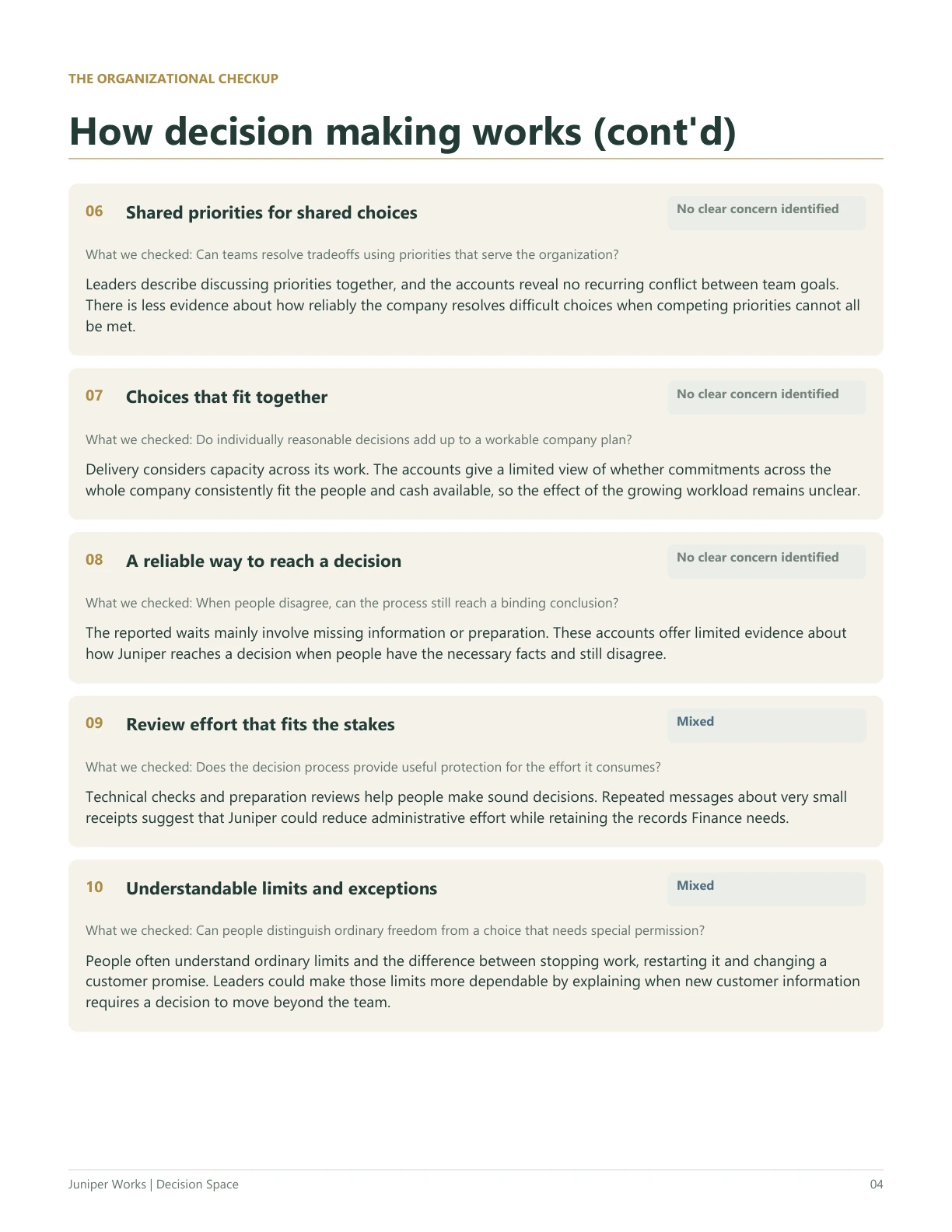
Shared priorities for shared choices
No clear concern identified
What we checked: Can teams resolve tradeoffs using priorities that serve the organization?
Leaders describe discussing priorities together, and the accounts reveal no recurring conflict between team goals.
There is less evidence about how reliably the company resolves difficult choices when competing priorities cannot all
be met.
07
Choices that fit together
No clear concern identified
What we checked: Do individually reasonable decisions add up to a workable company plan?
Delivery considers capacity across its work. The accounts give a limited view of whether commitments across the
whole company consistently fit the people and cash available, so the effect of the growing workload remains unclear.
08
A reliable way to reach a decision
No clear concern identified
What we checked: When people disagree, can the process still reach a binding conclusion?
The reported waits mainly involve missing information or preparation. These accounts offer limited evidence about
how Juniper reaches a decision when people have the necessary facts and still disagree.
09
Review effort that fits the stakes
Mixed
What we checked: Does the decision process provide useful protection for the effort it consumes?
Technical checks and preparation reviews help people make sound decisions. Repeated messages about very small
receipts suggest that Juniper could reduce administrative effort while retaining the records Finance needs.
10
Understandable limits and exceptions
Mixed
What we checked: Can people distinguish ordinary freedom from a choice that needs special permission?
People often understand ordinary limits and the difference between stopping work, restarting it and changing a
customer promise. Leaders could make those limits more dependable by explaining when new customer information
requires a decision to move beyond the team.
Juniper Works | Decision Space
04
Page 5 of 10
THE ORGANIZATIONAL CHECKUP
How decision making works (cont'd)
11
Promises grounded in authority and feasibility
No clear concern identified
What we checked: Can the company distinguish exploring an option from making a binding commitment?
Standard offers include checks on dates and feasibility. The accounts do not trace unusual customer promises closely
enough to establish who authorized them or when they became binding, so late notice alone supports a limited
conclusion.
12
Decisions that become coordinated action
Priority attention
What we checked: Once a choice is settled, can the organization put it into effect reliably?
Several customer transitions left contact ownership or necessary information unclear. Juniper should treat a
handover as complete when a receiving owner accepts it with the information and authority needed to act; an
unfinished issue list needs to be resolved as part of that preparation.
13
Freedom supported by readiness
Working well
What we checked: Do authorized people have the information, capability and support to use their freedom?
Guides, checklists and specialist advice help people make decisions within understood limits. Standard Support work,
pauses in data migration and product investigations show that employees can use local judgment with practical
support.
14
Arrangements that fit the organization today
No clear concern identified
What we checked: Have decision arrangements kept up with growth, complexity or a change in the business?
Juniper has grown and introduced a new management role, but the available history gives a limited basis for judging
how decision arrangements have adapted. The current handover gaps may have existed before the expansion.
15
Learning from decisions
No clear concern identified
What we checked: Does experience improve the decision arrangement, or simply repeat through workarounds?
Naming an accepting owner helped repair one handover. The accounts leave open whether the company adopted
that solution consistently or checked whether later handovers improved.
Juniper Works | Decision Space
05
Page 6 of 10
THE FIXED FUNCTIONAL LANDSCAPE
Shared decision spaces
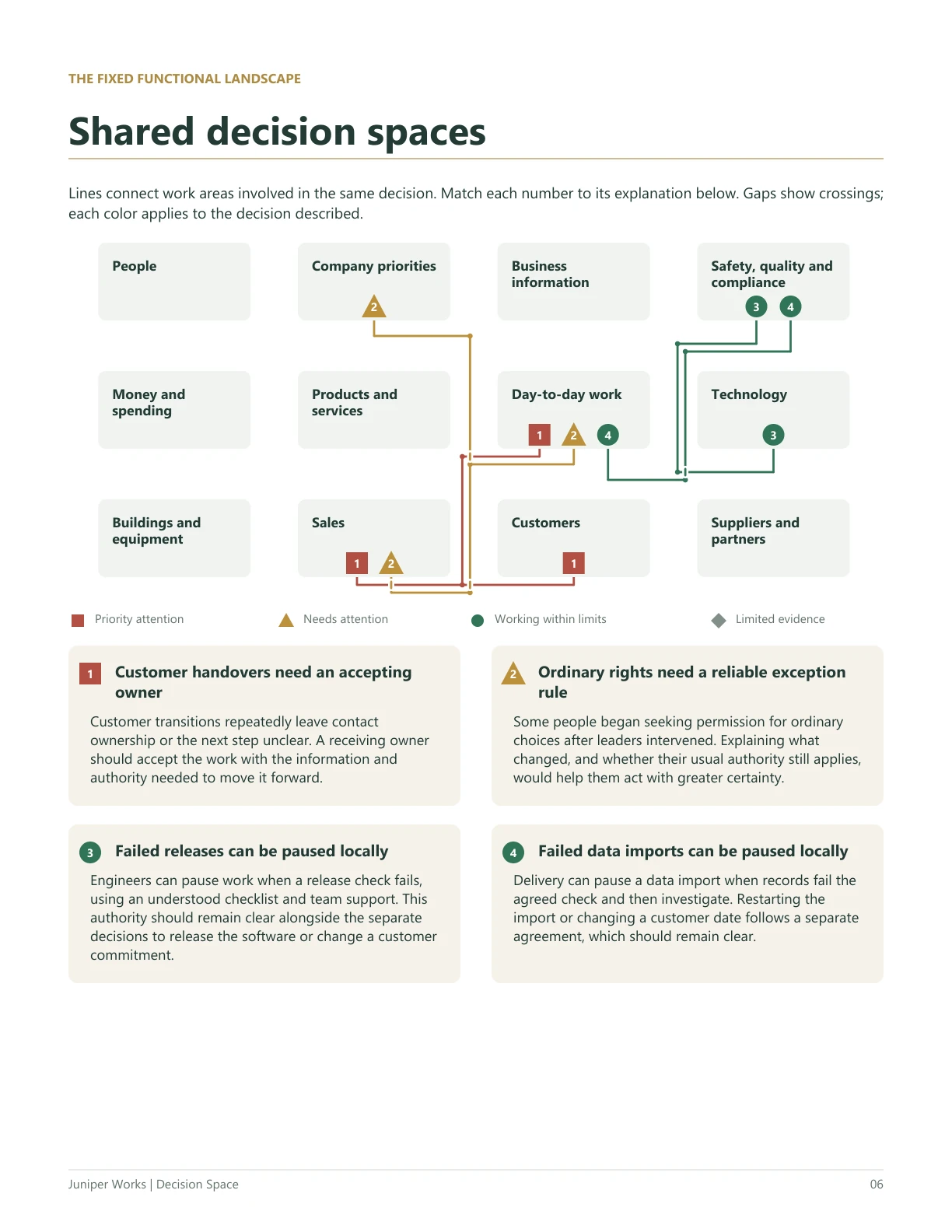
Lines connect work areas involved in the same decision. Match each number to its explanation below. Gaps show crossings;
each color applies to the decision described.
Company priorities
People
Money and
spending
Sales
Customers
Products and
services
Day-to-day work
Suppliers and
partners
Technology
Business
information
Safety, quality and
compliance
Buildings and
equipment
2
1
2
1
1
2
4
3
3
4
Priority attention
Needs attention
Working within limits
Limited evidence
1
Customer handovers need an accepting
owner
Customer transitions repeatedly leave contact
ownership or the next step unclear. A receiving owner
should accept the work with the information and
authority needed to move it forward.
2
Ordinary rights need a reliable exception
rule
Some people began seeking permission for ordinary
choices after leaders intervened. Explaining what
changed, and whether their usual authority still applies,
would help them act with greater certainty.
3
Failed releases can be paused locally
Engineers can pause work when a release check fails,
using an understood checklist and team support. This
authority should remain clear alongside the separate
decisions to release the software or change a customer
commitment.
4
Failed data imports can be paused locally
Delivery can pause a data import when records fail the
agreed check and then investigate. Restarting the
import or changing a customer date follows a separate
agreement, which should remain clear.
Juniper Works | Decision Space
06
Page 7 of 10
THE FIXED FUNCTIONAL LANDSCAPE
Shared decision spaces (cont'd)
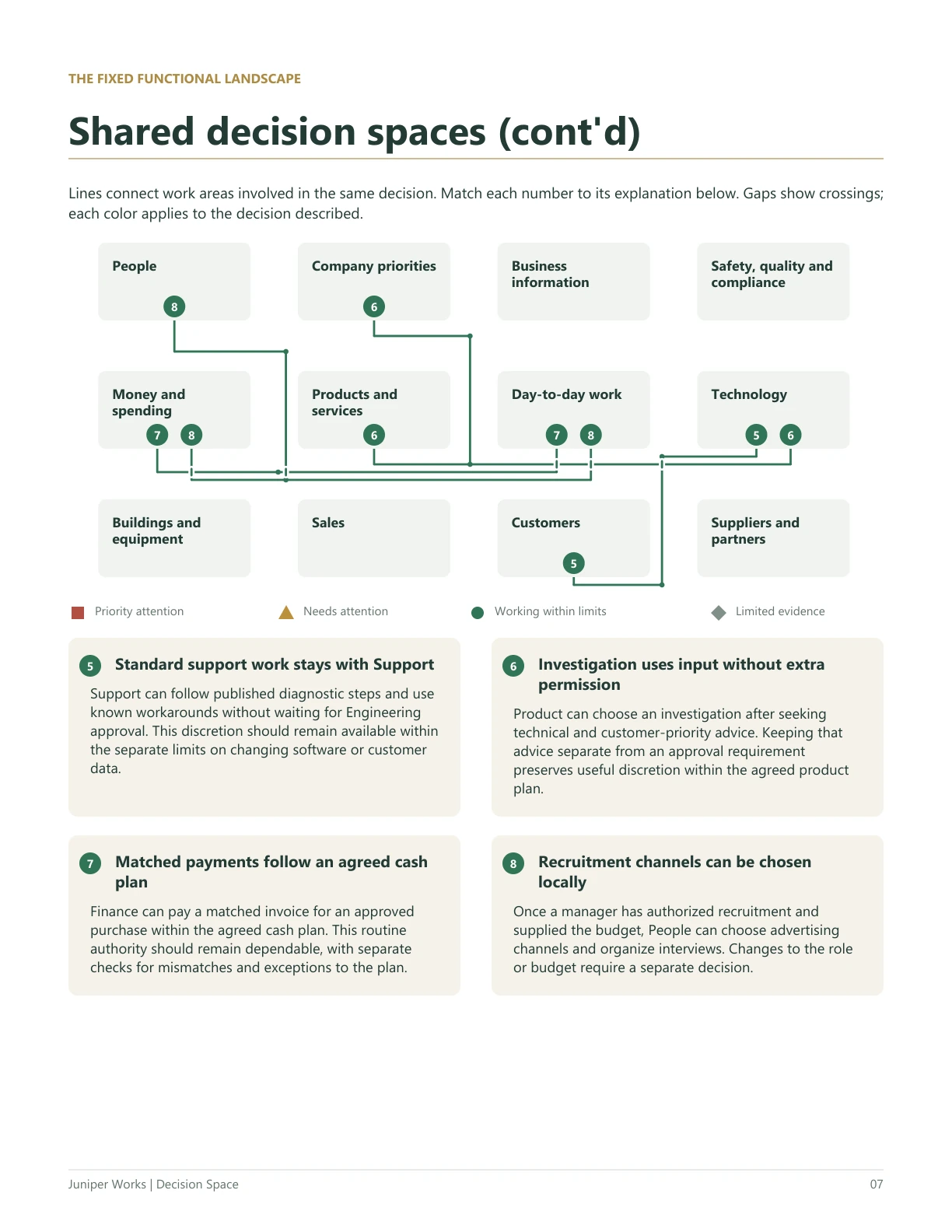
Lines connect work areas involved in the same decision. Match each number to its explanation below. Gaps show crossings;
each color applies to the decision described.
Company priorities
People
Money and
spending
Sales
Customers
Products and
services
Day-to-day work
Suppliers and
partners
Technology
Business
information
Safety, quality and
compliance
Buildings and
equipment
6
8
7
8
5
6
7
8
5
6
Priority attention
Needs attention
Working within limits
Limited evidence
5
Standard support work stays with Support
Support can follow published diagnostic steps and use
known workarounds without waiting for Engineering
approval. This discretion should remain available within
the separate limits on changing software or customer
data.
6
Investigation uses input without extra
permission
Product can choose an investigation after seeking
technical and customer-priority advice. Keeping that
advice separate from an approval requirement
preserves useful discretion within the agreed product
plan.
7
Matched payments follow an agreed cash
plan
Finance can pay a matched invoice for an approved
purchase within the agreed cash plan. This routine
authority should remain dependable, with separate
checks for mismatches and exceptions to the plan.
8
Recruitment channels can be chosen
locally
Once a manager has authorized recruitment and
supplied the budget, People can choose advertising
channels and organize interviews. Changes to the role
or budget require a separate decision.
Juniper Works | Decision Space
07
Page 8 of 10
DEPENDABLE DELEGATION
When leaders change a team decision
Managers describe being able to assign people to work within agreed delivery dates. Some began seeking
extra permission after leaders intervened in those choices. New customer information may justify a change, so
the important question is what the intervention tells people about their authority next time.
What participants described
A leader changed how a team had assigned its people after speaking with a customer, even though the
agreed dates remained the same. The person responsible then checked later allocations with a senior leader.
In another account, an employee began checking routine workshop dates with the founder after an
intervention, although the original offer remained in place.
Why it matters
People can understand that a decision belongs to them and still become reluctant to make it. When a leader
intervenes without explaining what changed, employees may treat future decisions as requiring approval.
The accounts support concern about that effect while leaving some of the customer circumstances
unresolved.
What should change
Leaders should explain the new information that requires a decision to change and say who will decide in
that situation. They should also confirm whether future choices within the original limits still belong to the
team. This would help employees distinguish advice from a requirement to seek approval.
Juniper Works | Decision Space
08
Page 9 of 10
RELIABLE CUSTOMER HANDOVERS
Make customer handovers dependable
Several accounts describe customer work passing from Commercial to Delivery or from implementation to
Support without a clear receiving owner or complete information. Some describe different customers, which
supports a recurring concern. The accounts provide a basis for improving the handover process, although they
do not establish the scale of any financial loss.
What participants described
Teams sometimes assumed that customer introductions or responsibility for the next contact had
transferred. Support also received work with an incomplete list of open issues. The immediate gaps were
resolved when someone accepted responsibility and received the information needed to act.
Why it matters
A customer can be left waiting when the sending team believes a handover is complete and the receiving
team is still waiting for information. Responsibility, information and the authority to take the next step need
to transfer together. An unfinished issue list can be a valid reason to wait, provided someone remains
responsible for completing it.
What should change
Each customer transition should have a named receiving owner who confirms acceptance. The teams should
agree what information must accompany the work and what the receiving owner can decide. Until the
handover is accepted or an exception is agreed, the current customer contact should remain responsible for
continuity.
Juniper Works | Decision Space
09
Page 10 of 10
RECOMMENDATIONS
Leadership priorities
Juniper can improve decision making by making a few existing agreements dependable. Customer
continuity deserves first attention, alongside clearer explanations when leaders change a delegated decision.
The company should preserve the local discretion and useful checks already supporting everyday work.
First priority: dependable customer handovers
Commercial, Delivery and Support leaders should agree when a receiving owner accepts responsibility, what
information must accompany the work and what that owner can decide. Keeping the current contact
responsible until acceptance would reduce the chance of a customer being left between teams.
A parallel priority: dependable delegation
Leaders should agree the limits of decisions that teams can make within an approved plan. When new facts
require intervention, explaining those facts and confirming the team's continuing authority would help people
act without seeking unnecessary permission.
A narrower improvement: simpler expense follow-up
Finance should review how it requests evidence for very small expenses. Clearer requests and fewer repeated
reminders could reduce administrative effort while preserving the records needed to support each claim.
Preserve useful local judgment
Technical stop rights, standard Support discretion
and specialist advice help people act within clear
limits. Finance can continue paying matched invoices
within its cash plan, while major commitments retain
the oversight already agreed.
Clarify the remaining exceptions
Leaders should establish what new customer
information justified individual interventions and
when unusual promises became binding. These
details would help refine the advice about exceptions
and commitments.
Juniper Works | Decision Space
10