
Page 1 of 12
AFTER ACTION REVIEW
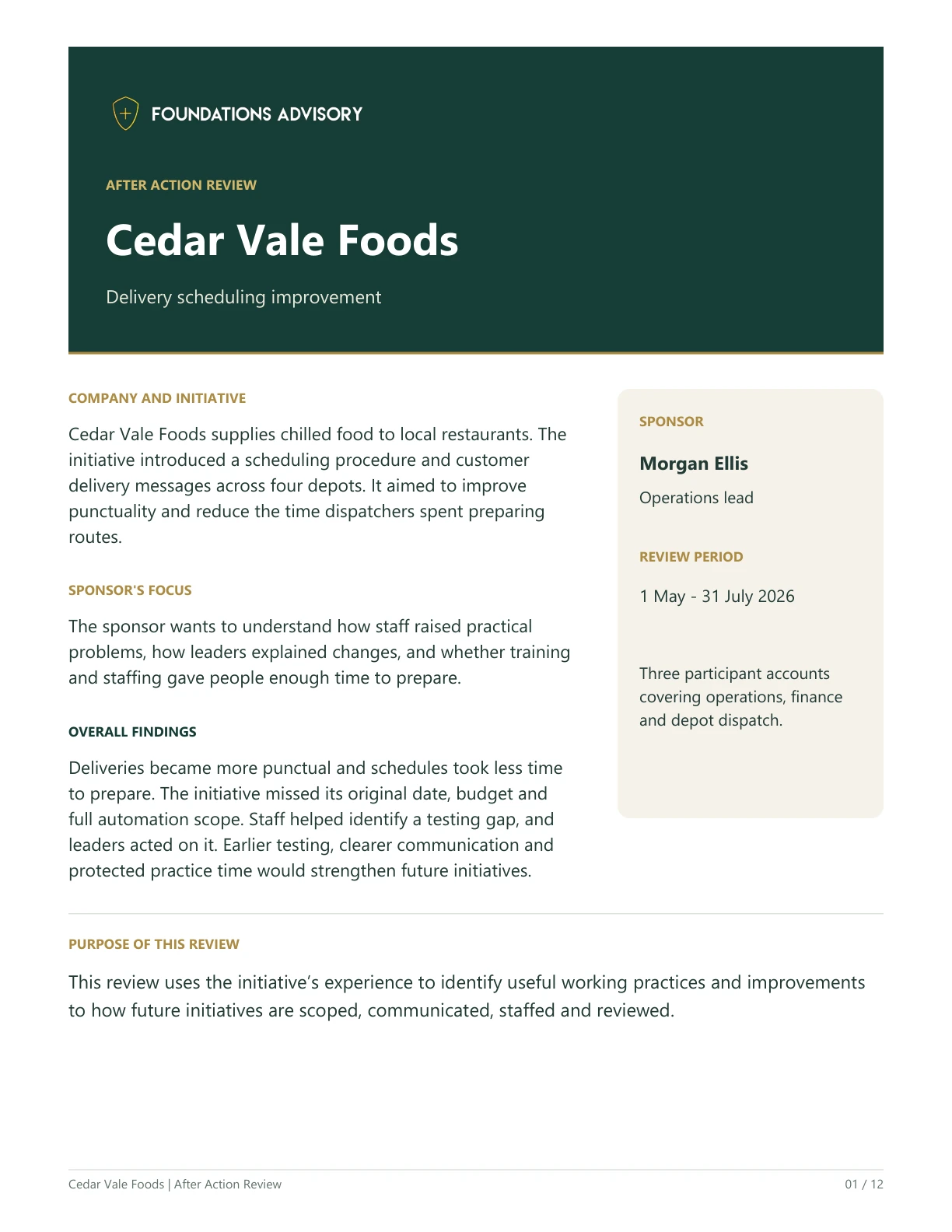
Cedar Vale Foods
Delivery scheduling improvement
COMPANY AND INITIATIVE
Cedar Vale Foods supplies chilled food to local restaurants. The
initiative introduced a scheduling procedure and customer
delivery messages across four depots. It aimed to improve
punctuality and reduce the time dispatchers spent preparing
routes.
SPONSOR'S FOCUS
The sponsor wants to understand how staff raised practical
problems, how leaders explained changes, and whether training
and staffing gave people enough time to prepare.
OVERALL FINDINGS
Deliveries became more punctual and schedules took less time
to prepare. The initiative missed its original date, budget and
full automation scope. Staff helped identify a testing gap, and
leaders acted on it. Earlier testing, clearer communication and
protected practice time would strengthen future initiatives.
SPONSOR
Morgan Ellis
Operations lead
REVIEW PERIOD
1 May - 31 July 2026
Three participant accounts
covering operations, finance
and depot dispatch.
PURPOSE OF THIS REVIEW
This review uses the initiative’s experience to identify useful working practices and improvements
to how future initiatives are scoped, communicated, staffed and reviewed.
Cedar Vale Foods | After Action Review
01 / 12
Page 2 of 12
AFTER ACTION REVIEW
Key Takeaways
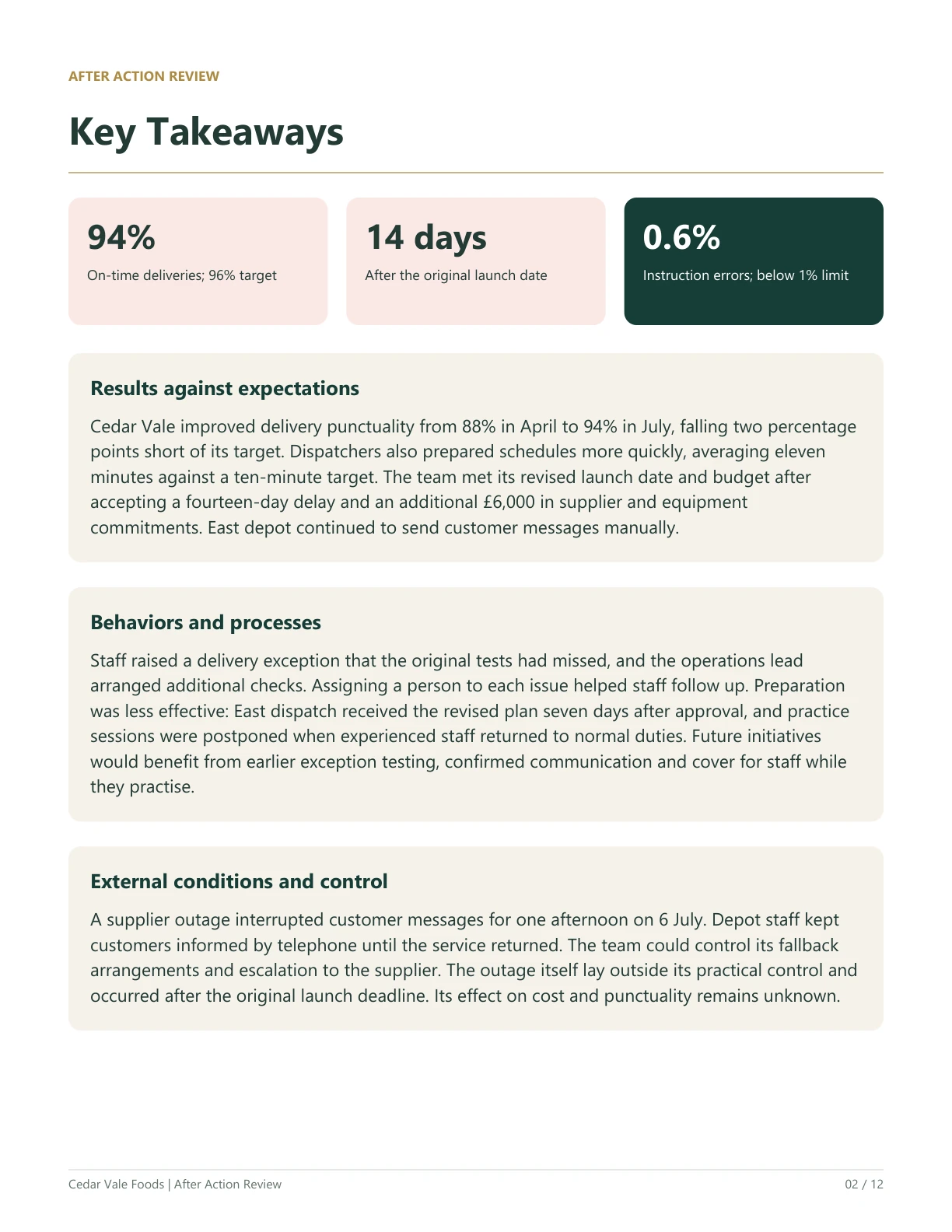
94%
On-time deliveries; 96% target
14 days
After the original launch date
0.6%
Instruction errors; below 1% limit
Results against expectations
Cedar Vale improved delivery punctuality from 88% in April to 94% in July, falling two percentage
points short of its target. Dispatchers also prepared schedules more quickly, averaging eleven
minutes against a ten-minute target. The team met its revised launch date and budget after
accepting a fourteen-day delay and an additional £6,000 in supplier and equipment
commitments. East depot continued to send customer messages manually.
Behaviors and processes
Staff raised a delivery exception that the original tests had missed, and the operations lead
arranged additional checks. Assigning a person to each issue helped staff follow up. Preparation
was less effective: East dispatch received the revised plan seven days after approval, and practice
sessions were postponed when experienced staff returned to normal duties. Future initiatives
would benefit from earlier exception testing, confirmed communication and cover for staff while
they practise.
External conditions and control
A supplier outage interrupted customer messages for one afternoon on 6 July. Depot staff kept
customers informed by telephone until the service returned. The team could control its fallback
arrangements and escalation to the supplier. The outage itself lay outside its practical control and
occurred after the original launch deadline. Its effect on cost and punctuality remains unknown.
Cedar Vale Foods | After Action Review
02 / 12
Page 3 of 12
AFTER ACTION REVIEW
Results Against Expectations
OUTCOMES AND VALUE
MISSED TARGET
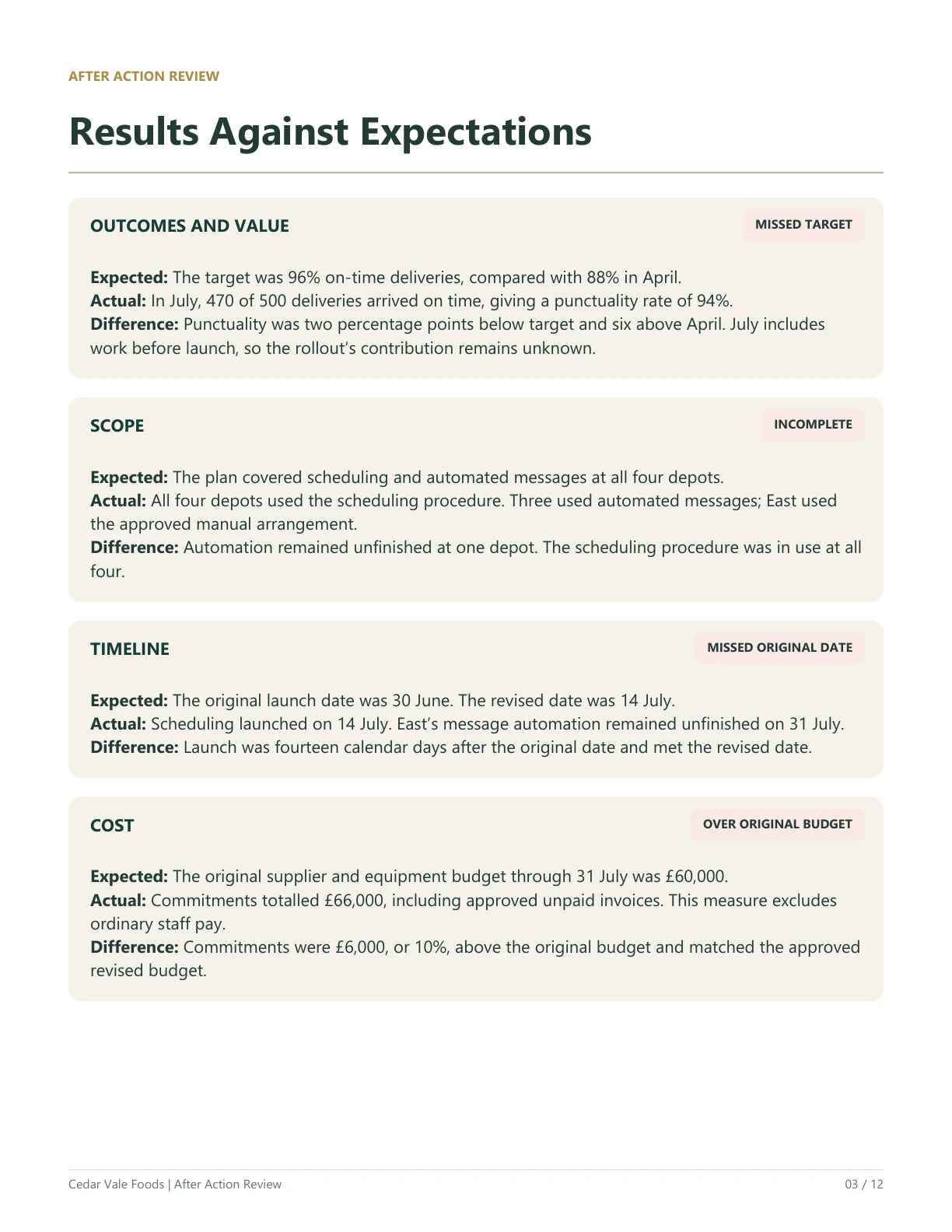
Expected: The target was 96% on-time deliveries, compared with 88% in April.
Actual: In July, 470 of 500 deliveries arrived on time, giving a punctuality rate of 94%.
Difference: Punctuality was two percentage points below target and six above April. July includes
work before launch, so the rollout’s contribution remains unknown.
SCOPE
INCOMPLETE
Expected: The plan covered scheduling and automated messages at all four depots.
Actual: All four depots used the scheduling procedure. Three used automated messages; East used
the approved manual arrangement.
Difference: Automation remained unfinished at one depot. The scheduling procedure was in use at all
four.
TIMELINE
MISSED ORIGINAL DATE
Expected: The original launch date was 30 June. The revised date was 14 July.
Actual: Scheduling launched on 14 July. East’s message automation remained unfinished on 31 July.
Difference: Launch was fourteen calendar days after the original date and met the revised date.
COST
OVER ORIGINAL BUDGET
Expected: The original supplier and equipment budget through 31 July was £60,000.
Actual: Commitments totalled £66,000, including approved unpaid invoices. This measure excludes
ordinary staff pay.
Difference: Commitments were £6,000, or 10%, above the original budget and matched the approved
revised budget.
Cedar Vale Foods | After Action Review
03 / 12
Page 4 of 12
AFTER ACTION REVIEW
Results Against Expectations (cont'd)
QUALITY
STANDARD MET
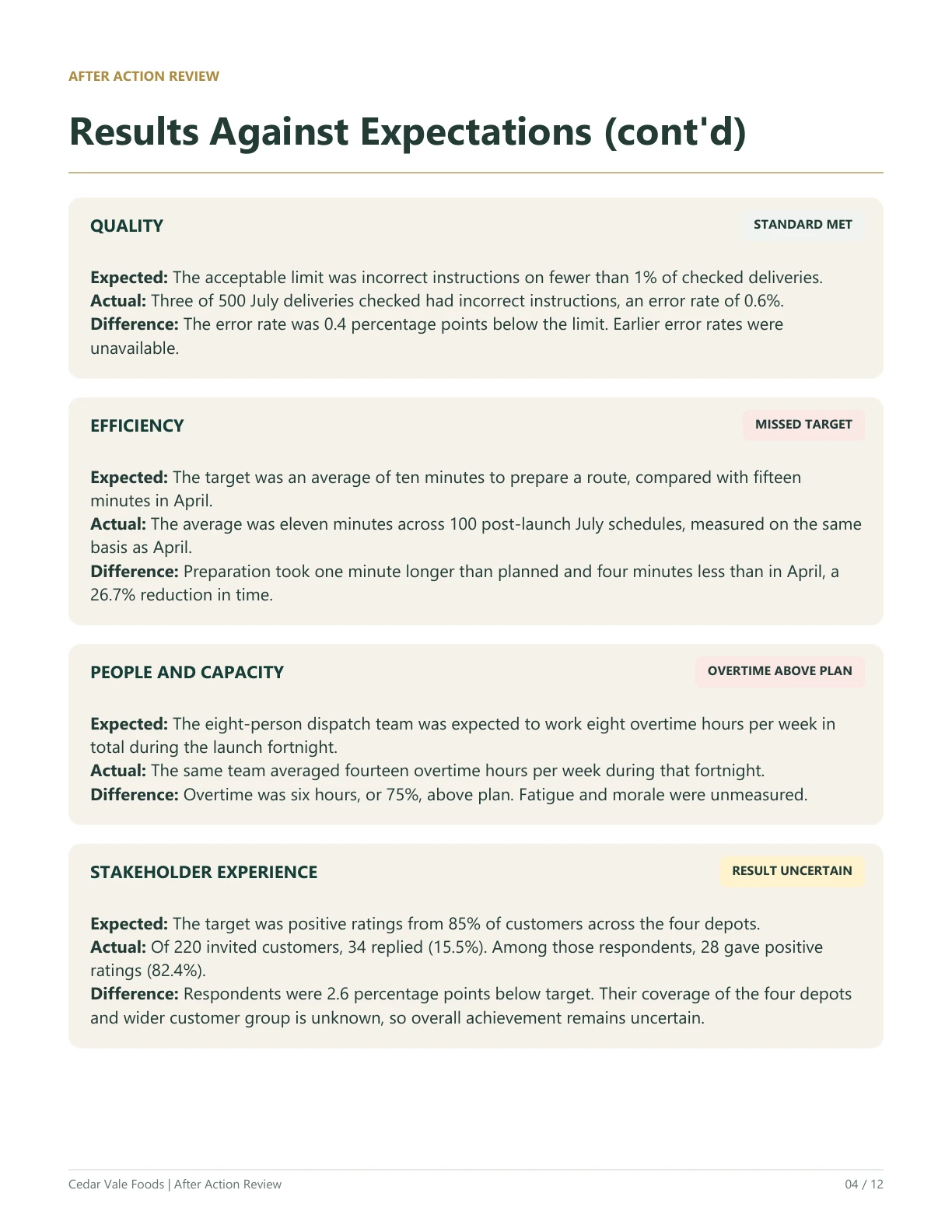
Expected: The acceptable limit was incorrect instructions on fewer than 1% of checked deliveries.
Actual: Three of 500 July deliveries checked had incorrect instructions, an error rate of 0.6%.
Difference: The error rate was 0.4 percentage points below the limit. Earlier error rates were
unavailable.
EFFICIENCY
MISSED TARGET
Expected: The target was an average of ten minutes to prepare a route, compared with fifteen
minutes in April.
Actual: The average was eleven minutes across 100 post-launch July schedules, measured on the same
basis as April.
Difference: Preparation took one minute longer than planned and four minutes less than in April, a
26.7% reduction in time.
PEOPLE AND CAPACITY
OVERTIME ABOVE PLAN
Expected: The eight-person dispatch team was expected to work eight overtime hours per week in
total during the launch fortnight.
Actual: The same team averaged fourteen overtime hours per week during that fortnight.
Difference: Overtime was six hours, or 75%, above plan. Fatigue and morale were unmeasured.
STAKEHOLDER EXPERIENCE
RESULT UNCERTAIN
Expected: The target was positive ratings from 85% of customers across the four depots.
Actual: Of 220 invited customers, 34 replied (15.5%). Among those respondents, 28 gave positive
ratings (82.4%).
Difference: Respondents were 2.6 percentage points below target. Their coverage of the four depots
and wider customer group is unknown, so overall achievement remains uncertain.
Cedar Vale Foods | After Action Review
04 / 12
Page 5 of 12
AFTER ACTION REVIEW
Initiative Timeline
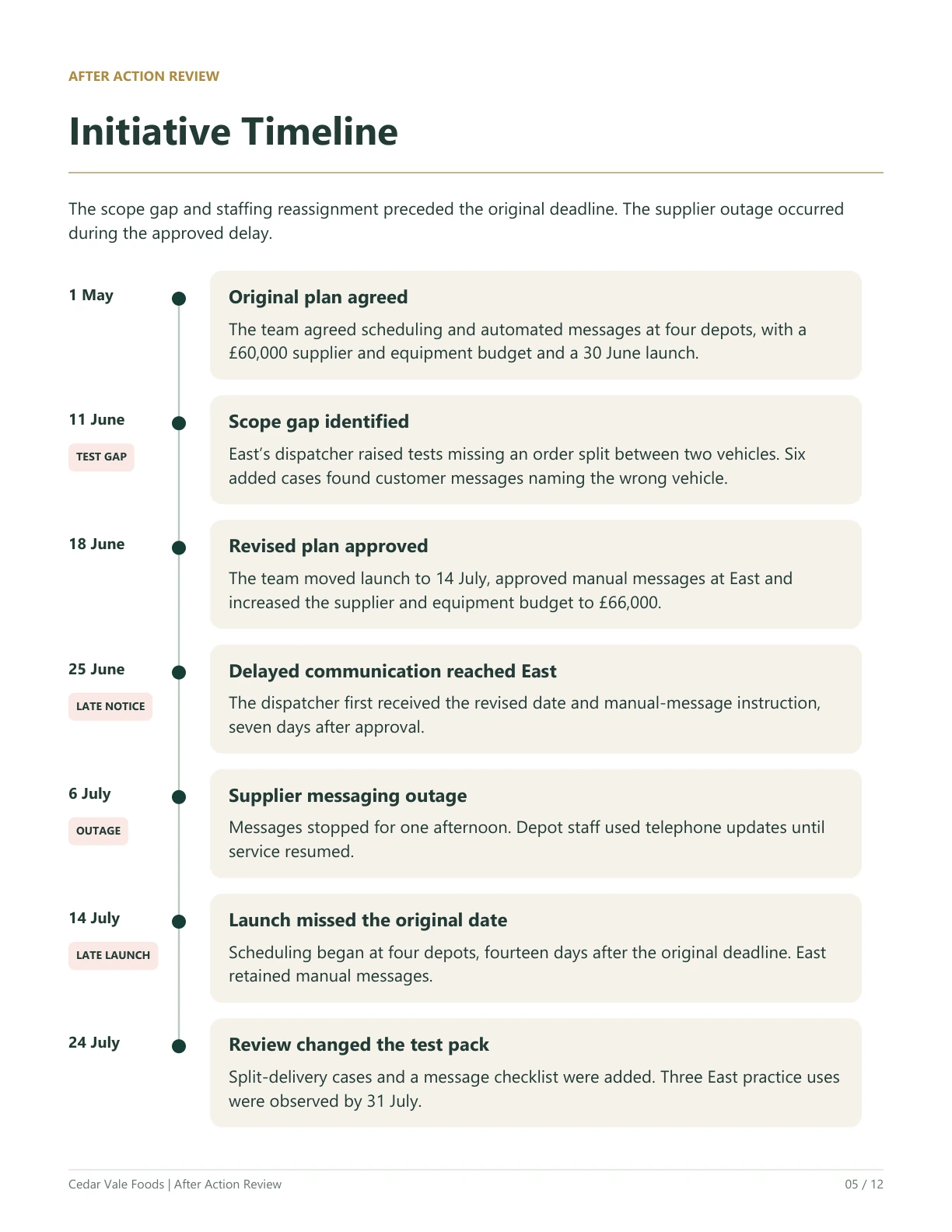
The scope gap and staffing reassignment preceded the original deadline. The supplier outage occurred
during the approved delay.
1 May
Original plan agreed
The team agreed scheduling and automated messages at four depots, with a
£60,000 supplier and equipment budget and a 30 June launch.
11 June
TEST GAP
Scope gap identified
East’s dispatcher raised tests missing an order split between two vehicles. Six
added cases found customer messages naming the wrong vehicle.
18 June
Revised plan approved
The team moved launch to 14 July, approved manual messages at East and
increased the supplier and equipment budget to £66,000.
25 June
LATE NOTICE
Delayed communication reached East
The dispatcher first received the revised date and manual-message instruction,
seven days after approval.
6 July
OUTAGE
Supplier messaging outage
Messages stopped for one afternoon. Depot staff used telephone updates until
service resumed.
14 July
LATE LAUNCH
Launch missed the original date
Scheduling began at four depots, fourteen days after the original deadline. East
retained manual messages.
24 July
Review changed the test pack
Split-delivery cases and a message checklist were added. Three East practice uses
were observed by 31 July.
Cedar Vale Foods | After Action Review
05 / 12
Page 6 of 12
AFTER ACTION REVIEW
Behaviors and Processes
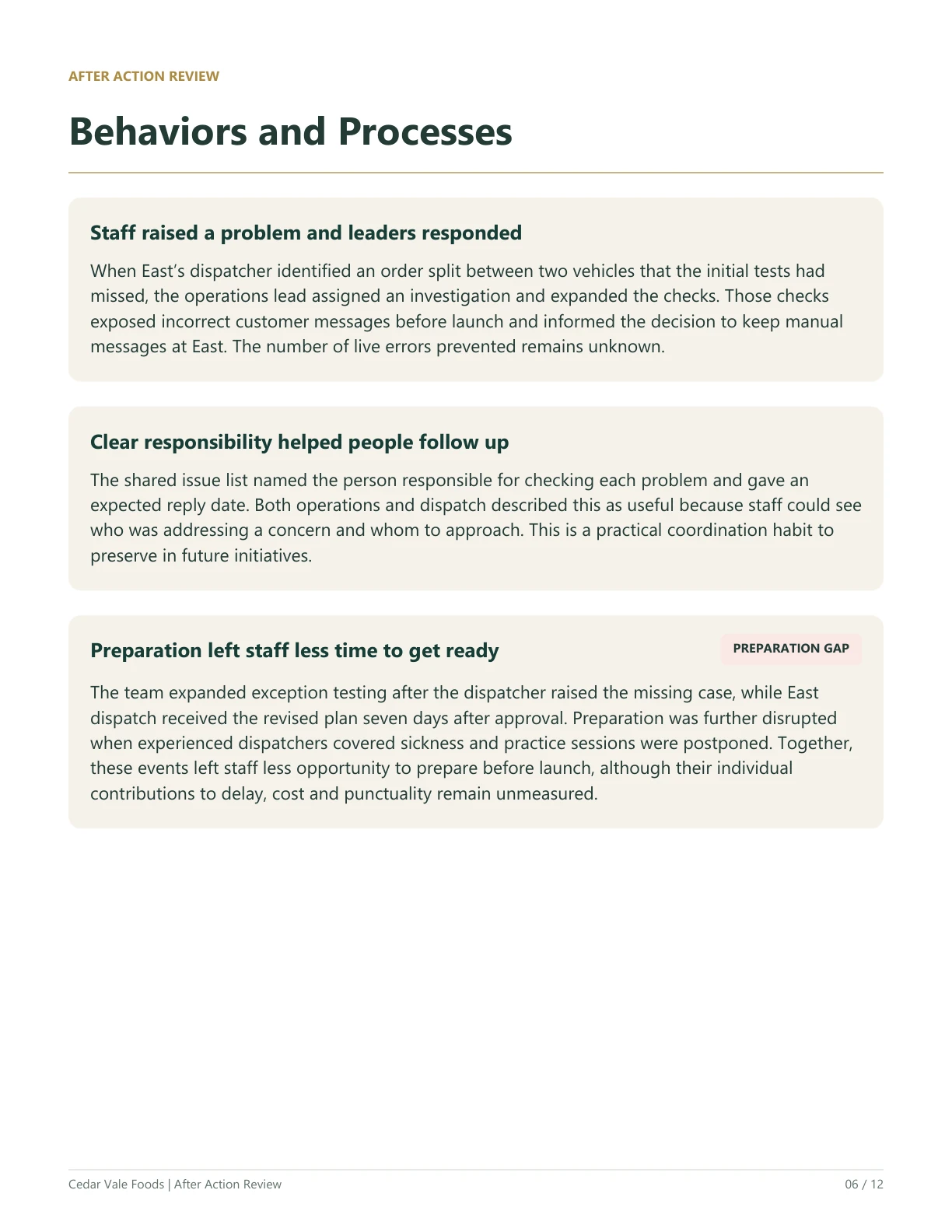
Staff raised a problem and leaders responded
When East’s dispatcher identified an order split between two vehicles that the initial tests had
missed, the operations lead assigned an investigation and expanded the checks. Those checks
exposed incorrect customer messages before launch and informed the decision to keep manual
messages at East. The number of live errors prevented remains unknown.
Clear responsibility helped people follow up
The shared issue list named the person responsible for checking each problem and gave an
expected reply date. Both operations and dispatch described this as useful because staff could see
who was addressing a concern and whom to approach. This is a practical coordination habit to
preserve in future initiatives.
Preparation left staff less time to get ready
PREPARATION GAP
The team expanded exception testing after the dispatcher raised the missing case, while East
dispatch received the revised plan seven days after approval. Preparation was further disrupted
when experienced dispatchers covered sickness and practice sessions were postponed. Together,
these events left staff less opportunity to prepare before launch, although their individual
contributions to delay, cost and punctuality remain unmeasured.
Cedar Vale Foods | After Action Review
06 / 12
Page 7 of 12
AFTER ACTION REVIEW
Scoping Assessment
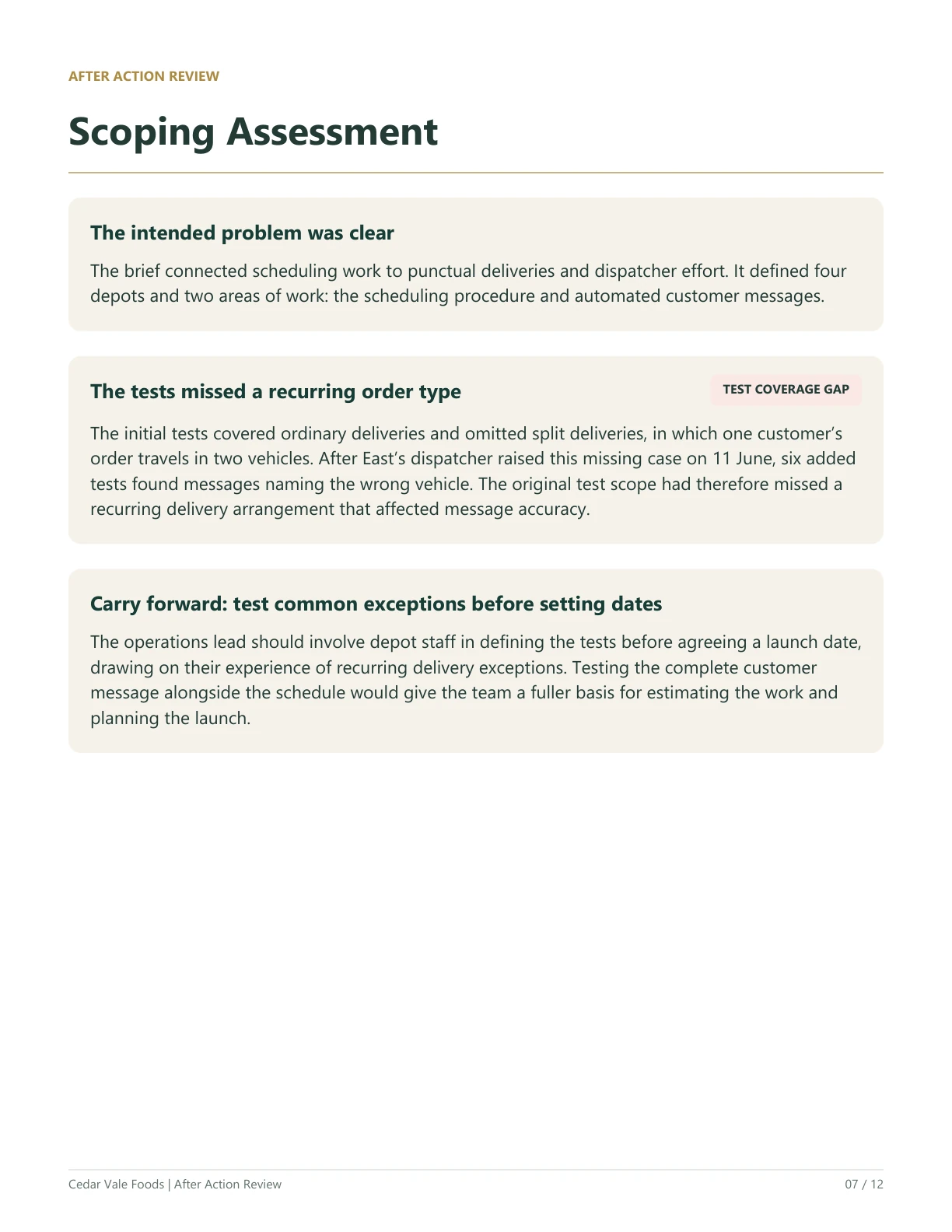
The intended problem was clear
The brief connected scheduling work to punctual deliveries and dispatcher effort. It defined four
depots and two areas of work: the scheduling procedure and automated customer messages.
The tests missed a recurring order type
TEST COVERAGE GAP
The initial tests covered ordinary deliveries and omitted split deliveries, in which one customer’s
order travels in two vehicles. After East’s dispatcher raised this missing case on 11 June, six added
tests found messages naming the wrong vehicle. The original test scope had therefore missed a
recurring delivery arrangement that affected message accuracy.
Carry forward: test common exceptions before setting dates
The operations lead should involve depot staff in defining the tests before agreeing a launch date,
drawing on their experience of recurring delivery exceptions. Testing the complete customer
message alongside the schedule would give the team a fuller basis for estimating the work and
planning the launch.
Cedar Vale Foods | After Action Review
07 / 12
Page 8 of 12
AFTER ACTION REVIEW
Decision Making Assessment
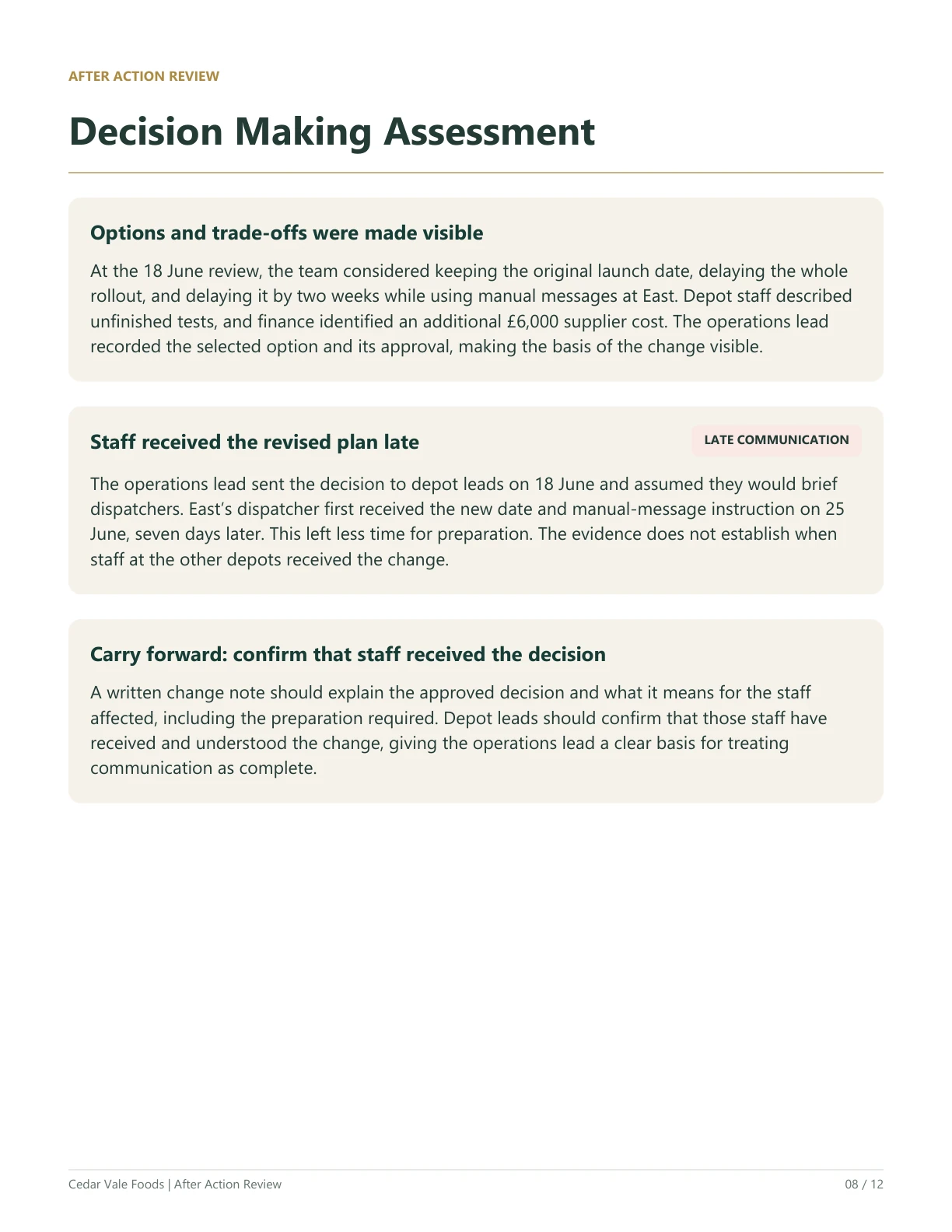
Options and trade-offs were made visible
At the 18 June review, the team considered keeping the original launch date, delaying the whole
rollout, and delaying it by two weeks while using manual messages at East. Depot staff described
unfinished tests, and finance identified an additional £6,000 supplier cost. The operations lead
recorded the selected option and its approval, making the basis of the change visible.
Staff received the revised plan late
LATE COMMUNICATION
The operations lead sent the decision to depot leads on 18 June and assumed they would brief
dispatchers. East’s dispatcher first received the new date and manual-message instruction on 25
June, seven days later. This left less time for preparation. The evidence does not establish when
staff at the other depots received the change.
Carry forward: confirm that staff received the decision
A written change note should explain the approved decision and what it means for the staff
affected, including the preparation required. Depot leads should confirm that those staff have
received and understood the change, giving the operations lead a clear basis for treating
communication as complete.
Cedar Vale Foods | After Action Review
08 / 12
Page 9 of 12
AFTER ACTION REVIEW
Execution Assessment
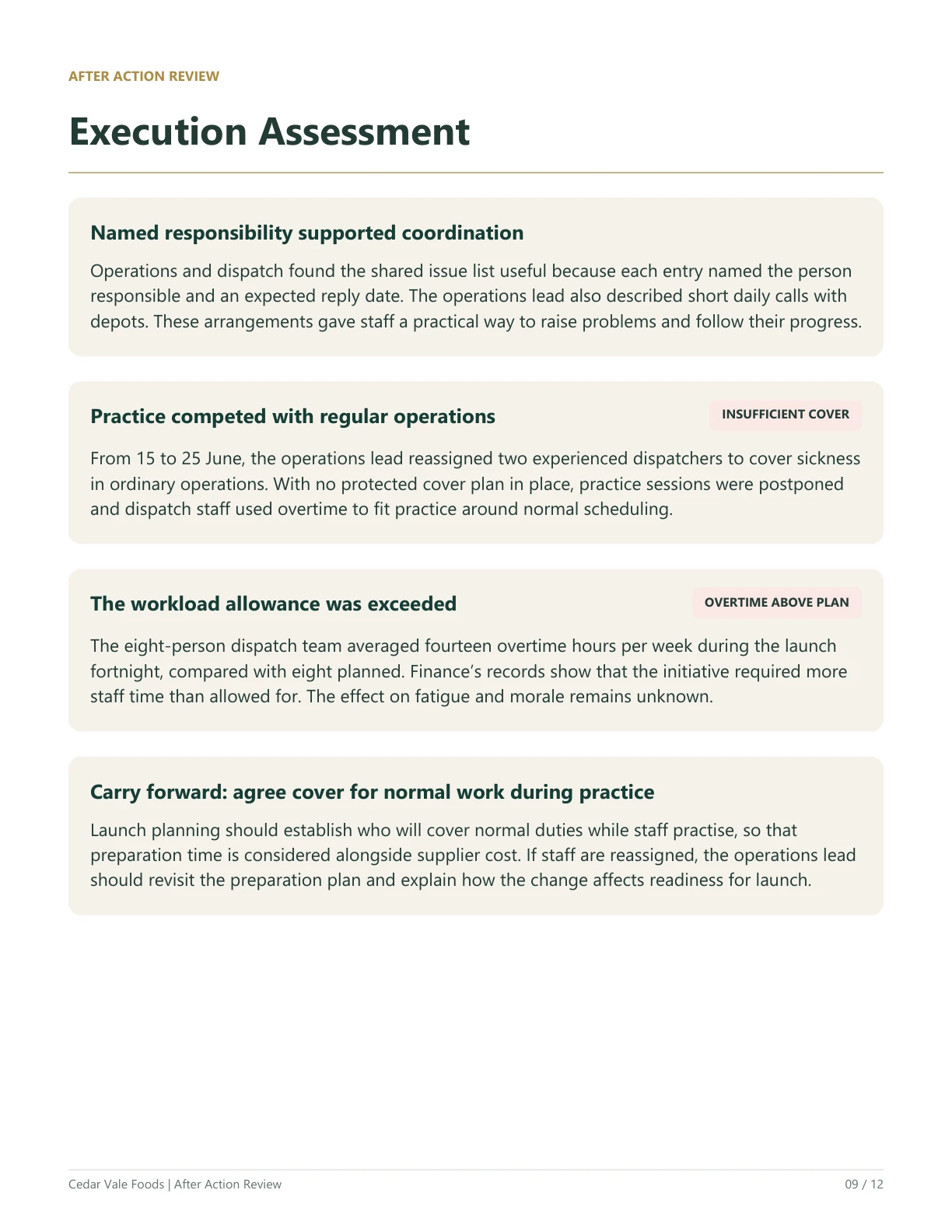
Named responsibility supported coordination
Operations and dispatch found the shared issue list useful because each entry named the person
responsible and an expected reply date. The operations lead also described short daily calls with
depots. These arrangements gave staff a practical way to raise problems and follow their progress.
Practice competed with regular operations
INSUFFICIENT COVER
From 15 to 25 June, the operations lead reassigned two experienced dispatchers to cover sickness
in ordinary operations. With no protected cover plan in place, practice sessions were postponed
and dispatch staff used overtime to fit practice around normal scheduling.
The workload allowance was exceeded
OVERTIME ABOVE PLAN
The eight-person dispatch team averaged fourteen overtime hours per week during the launch
fortnight, compared with eight planned. Finance’s records show that the initiative required more
staff time than allowed for. The effect on fatigue and morale remains unknown.
Carry forward: agree cover for normal work during practice
Launch planning should establish who will cover normal duties while staff practise, so that
preparation time is considered alongside supplier cost. If staff are reassigned, the operations lead
should revisit the preparation plan and explain how the change affects readiness for launch.
Cedar Vale Foods | After Action Review
09 / 12
Page 10 of 12
AFTER ACTION REVIEW
Learning Assessment
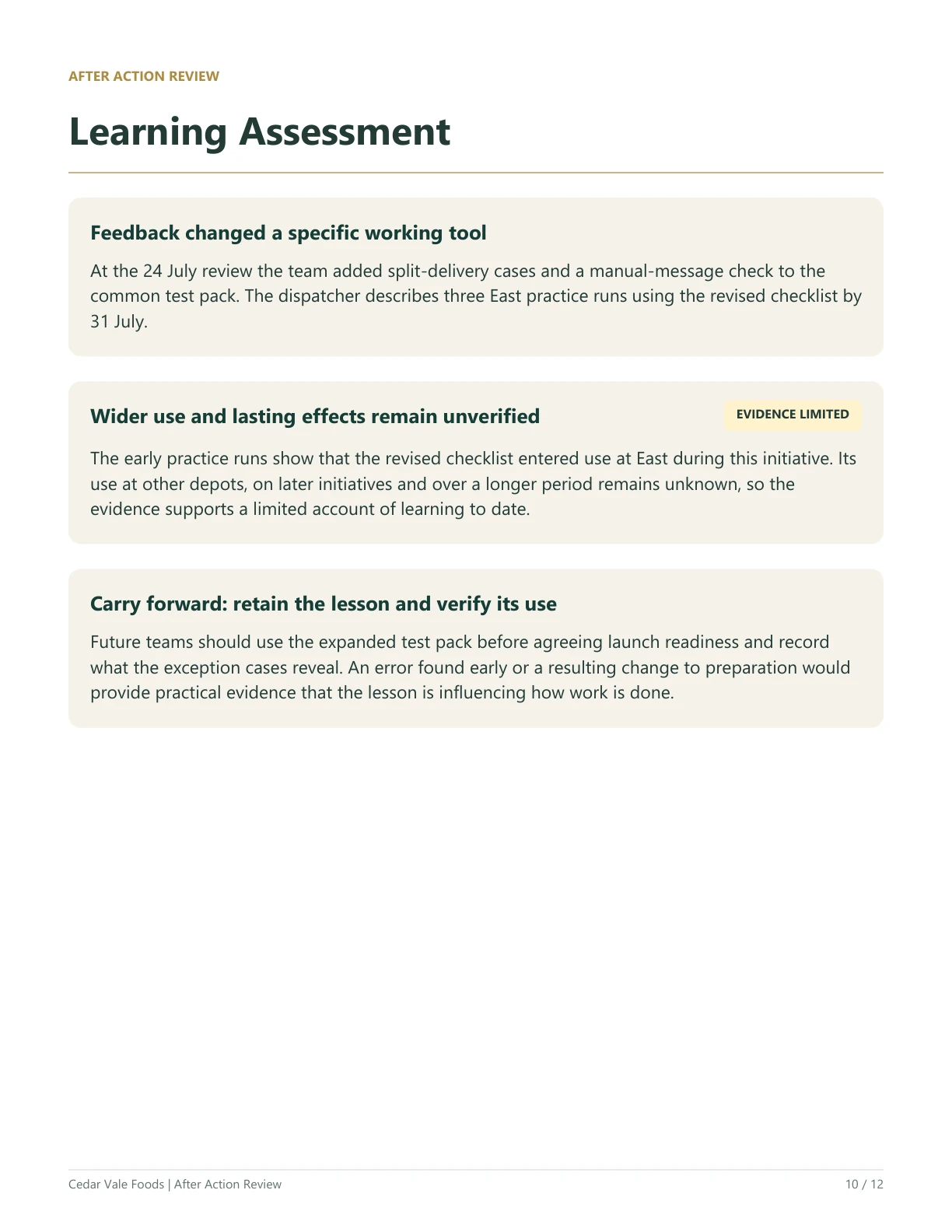
Feedback changed a specific working tool
At the 24 July review the team added split-delivery cases and a manual-message check to the
common test pack. The dispatcher describes three East practice runs using the revised checklist by
31 July.
Wider use and lasting effects remain unverified
EVIDENCE LIMITED
The early practice runs show that the revised checklist entered use at East during this initiative. Its
use at other depots, on later initiatives and over a longer period remains unknown, so the
evidence supports a limited account of learning to date.
Carry forward: retain the lesson and verify its use
Future teams should use the expanded test pack before agreeing launch readiness and record
what the exception cases reveal. An error found early or a resulting change to preparation would
provide practical evidence that the lesson is influencing how work is done.
Cedar Vale Foods | After Action Review
10 / 12
Page 11 of 12
AFTER ACTION REVIEW
External Factors and Control
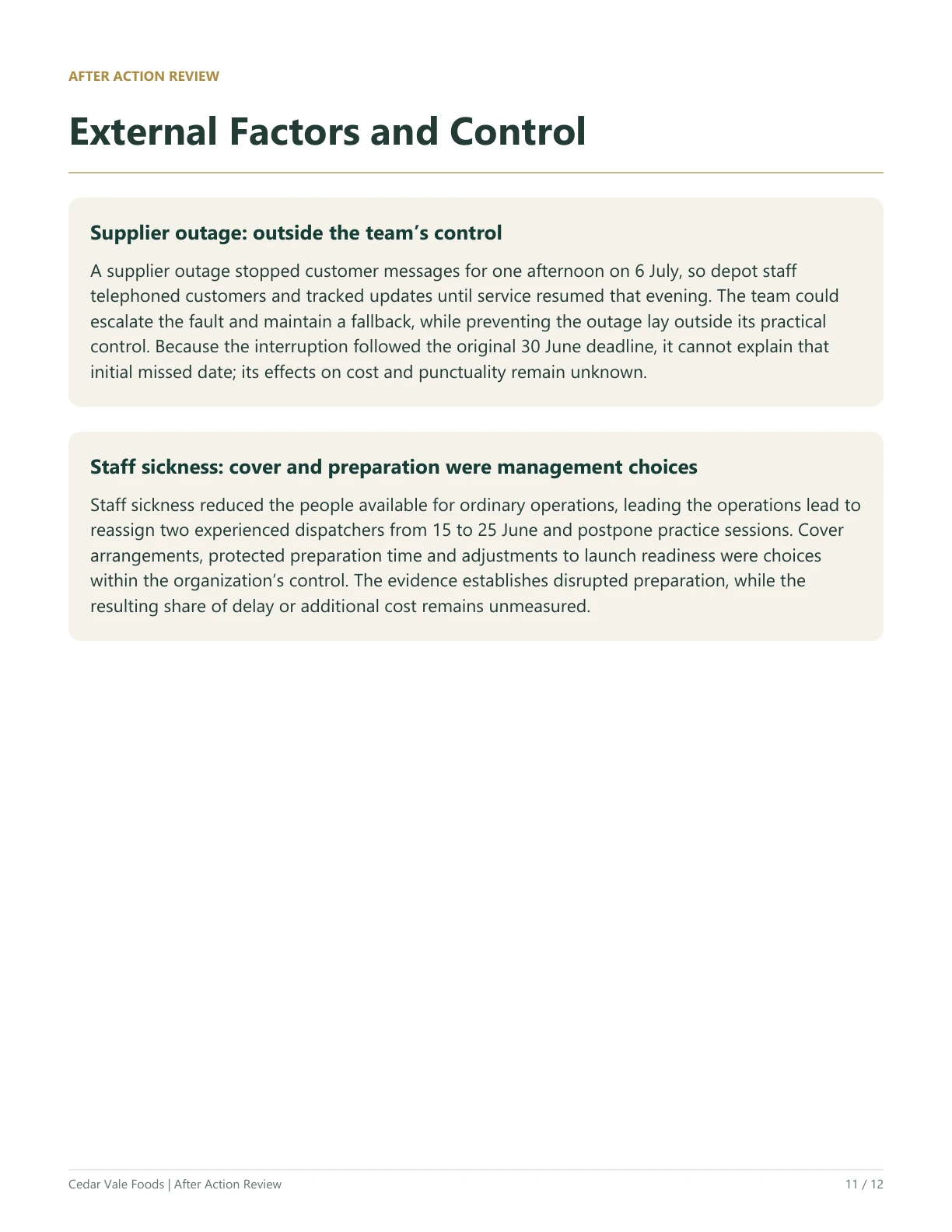
Supplier outage: outside the team’s control
A supplier outage stopped customer messages for one afternoon on 6 July, so depot staff
telephoned customers and tracked updates until service resumed that evening. The team could
escalate the fault and maintain a fallback, while preventing the outage lay outside its practical
control. Because the interruption followed the original 30 June deadline, it cannot explain that
initial missed date; its effects on cost and punctuality remain unknown.
Staff sickness: cover and preparation were management choices
Staff sickness reduced the people available for ordinary operations, leading the operations lead to
reassign two experienced dispatchers from 15 to 25 June and postpone practice sessions. Cover
arrangements, protected preparation time and adjustments to launch readiness were choices
within the organization’s control. The evidence establishes disrupted preparation, while the
resulting share of delay or additional cost remains unmeasured.
Cedar Vale Foods | After Action Review
11 / 12
Page 12 of 12
AFTER ACTION REVIEW
Practices to Preserve and Change
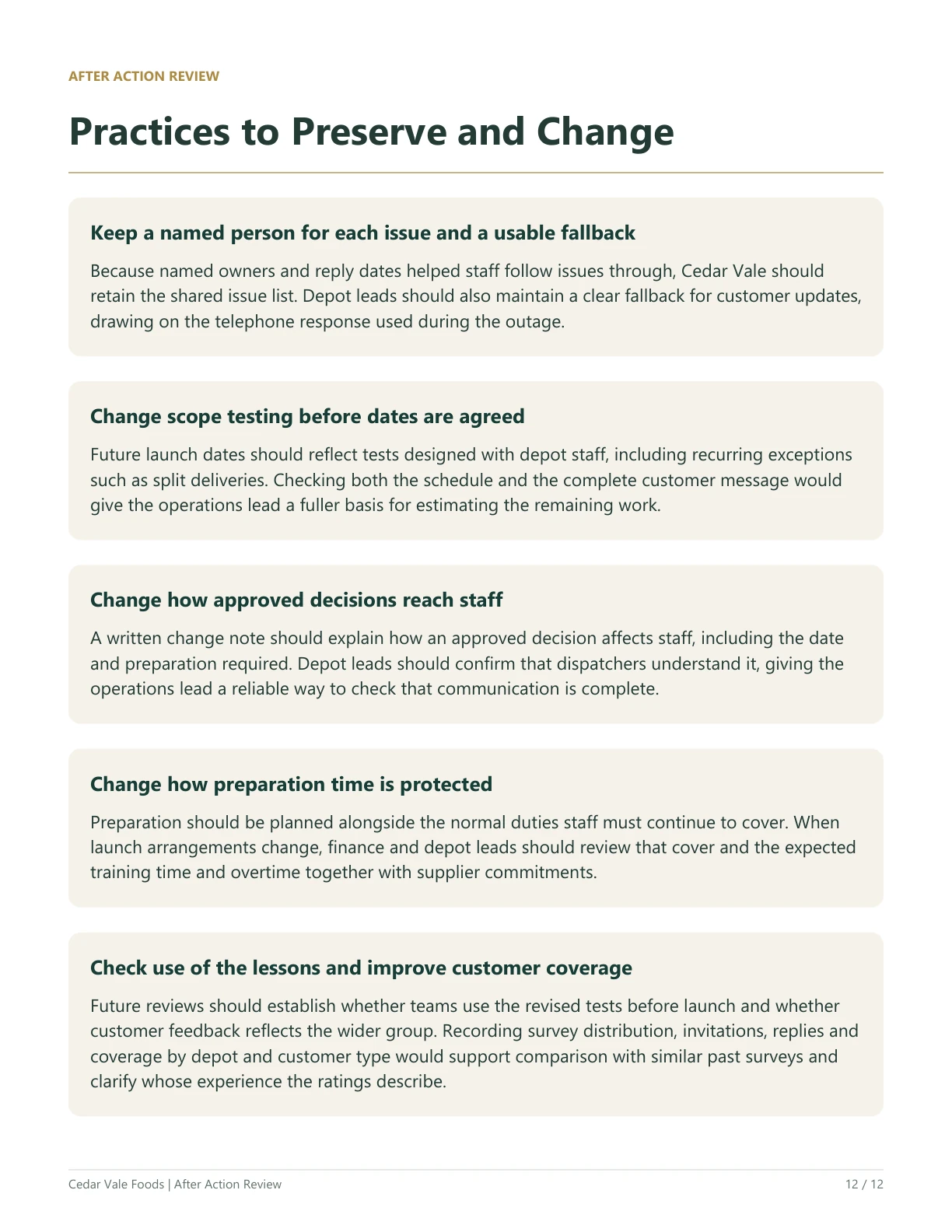
Keep a named person for each issue and a usable fallback
Because named owners and reply dates helped staff follow issues through, Cedar Vale should
retain the shared issue list. Depot leads should also maintain a clear fallback for customer updates,
drawing on the telephone response used during the outage.
Change scope testing before dates are agreed
Future launch dates should reflect tests designed with depot staff, including recurring exceptions
such as split deliveries. Checking both the schedule and the complete customer message would
give the operations lead a fuller basis for estimating the remaining work.
Change how approved decisions reach staff
A written change note should explain how an approved decision affects staff, including the date
and preparation required. Depot leads should confirm that dispatchers understand it, giving the
operations lead a reliable way to check that communication is complete.
Change how preparation time is protected
Preparation should be planned alongside the normal duties staff must continue to cover. When
launch arrangements change, finance and depot leads should review that cover and the expected
training time and overtime together with supplier commitments.
Check use of the lessons and improve customer coverage
Future reviews should establish whether teams use the revised tests before launch and whether
customer feedback reflects the wider group. Recording survey distribution, invitations, replies and
coverage by depot and customer type would support comparison with similar past surveys and
clarify whose experience the ratings describe.
Cedar Vale Foods | After Action Review
12 / 12